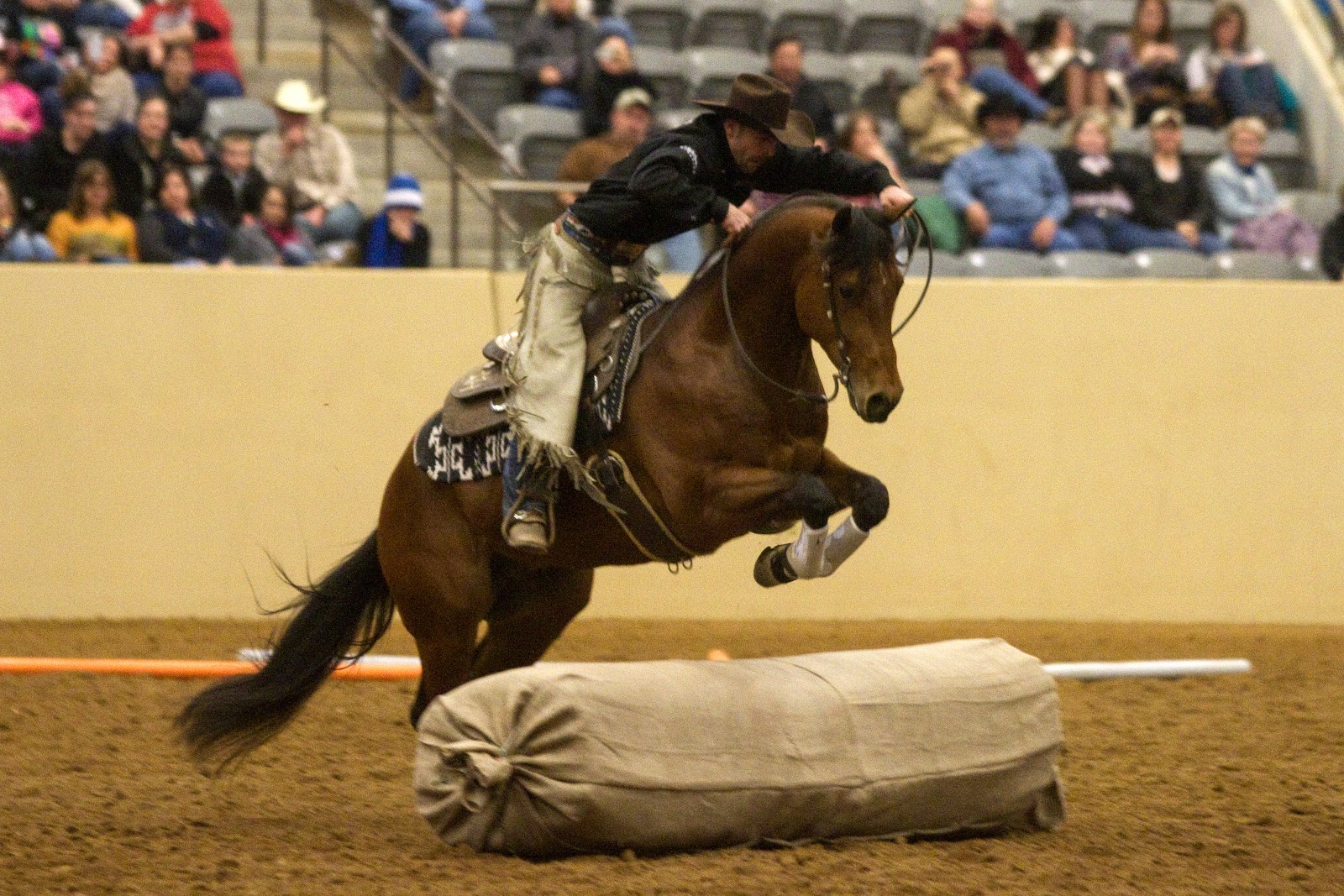
Road to the Horse doubling the challenge

Jim Anderson

 Road to the Horse has become one of the premier horse training competitions in the country. Selected trainers (usually 3 or 4) choose a horse out of the 6666 AQHA Remuda — a herd of 21 untouched 3-year-olds. The goal is to teach horsemen and women that natural horsemanship is a kinder training method. The trainers are judged not just in the final outcome, but how they got there. Chris Cox has captured three Road to the Horse titles. Guy McLean has captured two, and last year the wild card trainer beat his famous competitors to take the title.

Although I’m a huge fan of natural horsemanship methods — I’ve seen it work miracles on countless horses as well as put a wonderful foundation on young horses that lasts them a lifetime — the speed of the training is at once impressive and counter-intuitive into going slowly with training. Unlike the Robert Redford film “The Horse Whisperer” from which these type of natural horsemanship trainers got a boost in their fame, they don’t have unlimited time to allow the horse to control the pace of his own training. These horses reach an incredible level of training in just a weekend.

The 2014 AQHA Remuda from the renowned 6666 ranch.

 This year’s competition will return to the Kentucky Horse Park in Lexington, Kentucky, on March 26 to March 29, 2015 with the running of the Remuda on Friday morning around 10 a.m. And this year they are adding a new twist. Each competitor will select two horses to train instead of just one. The winner will be calculated on an accumulative score from both colts. The reason for the double duty? They want to show the trainers’ ability to adapt their training to different personalities.

Jonathan Field

Three-time winner Chris Cox will return to the lineup in 2015. And 2014 Champion and Wild Card Champion Jim Anderson will also return. Those two will face the 2015 Wild Card winner, who will be announced at the start of the event.

In addition to the trainers’ competition, a group of fans will be randomly drawn from the list of Road to Horse 2015 ticket purchasers. Those fans will then each select a colt from the Remuda. The fan who selected the highest-scoring horse at the event will receive a check for $10,000. Start checking out those horses now and make your picks! (Meet the 2015 Remuda here.)

Antoine Cloux (Switzerland)

Lexington, Kentucky, is an easy trip from Roanoke, Virginia, with a drive time of just under 6 hours. And if you’ve never been to Lexington, Kentucky, it’s worth the trip just to visit the town centered around great horses and horse farms. Road to the Horse 2015 tickets Ticket prices range from $83.00 to $203 per seat and are good for all 3 days. They are available online at www.RoadtotheHorse.com.

All photos are courtesy of Road to the Horse.
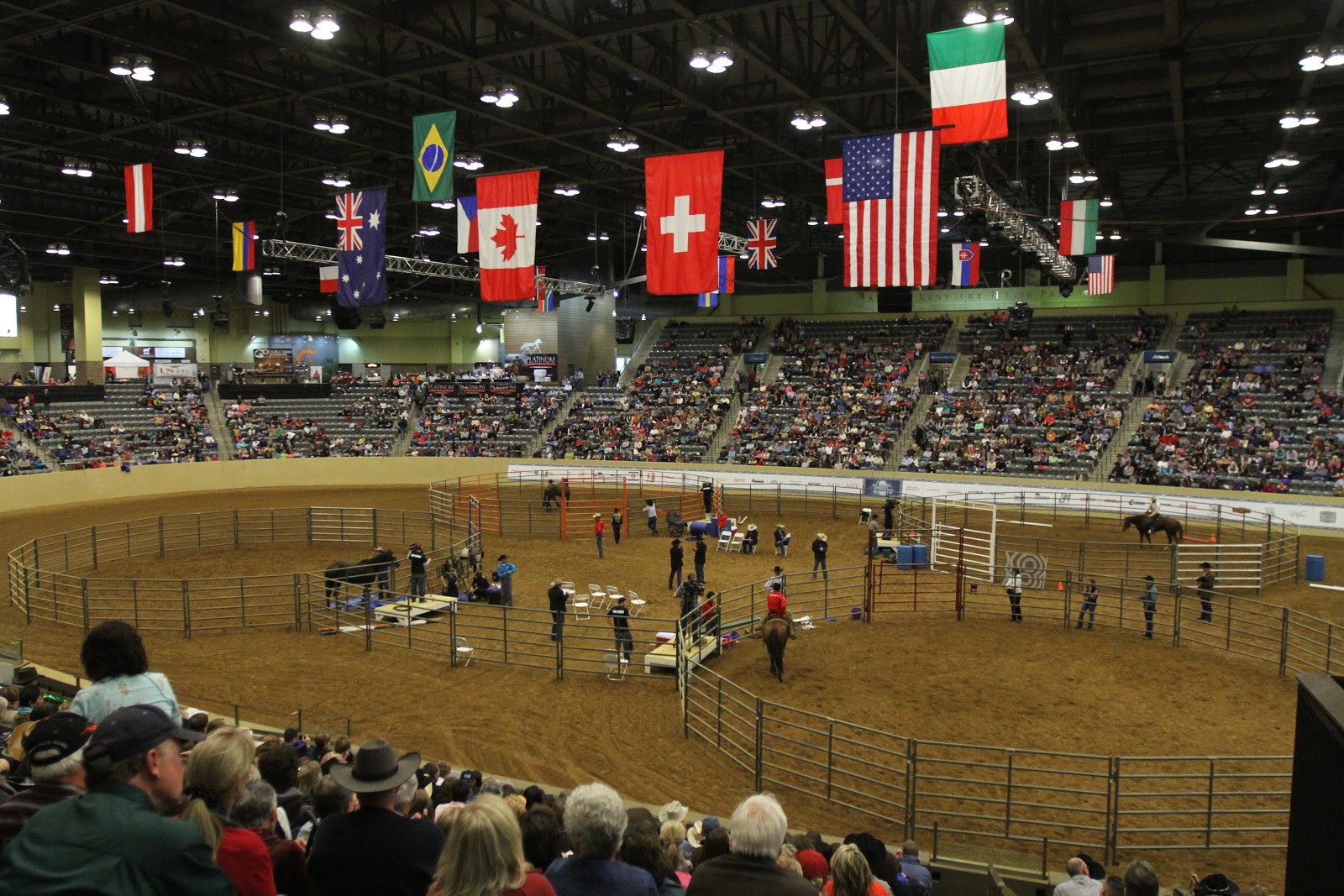
Road to the Horse 2014

Get your horse fix: Happening this weekend (Sept. 13-14, 2014)

This weekend is the Virginia 4-H State Championship Horse Show at the Virginia Horse Center. It opens Thursday evening with a Reining qualifier class and Hunter Showmanship in the coliseum. If you like your day watching at the horse show to be broken up by plenty of variety, this is a great place to go watch. Not only have these youth exhibitors from across the state worked very hard to get to the state show, there’s plenty of different types of action going on throughout the day. Even the most hardcore horse show fans can get a little fatigued after hours of the same discipline cantering along in front of them.  But at the state 4-H show there are 4 arenas running at the same time. For instance, on Saturday around noon, the Coliseum will be the site of Western Horsemanship, while in other arenas you can watch Driving, Hunter horses or hunter ponies. Find the full show schedule for more on class times and arenas.

If AQHA is more your cup of tea, you’ll have to travel all the way over to Doswell, Virginia, for the Virginia Bred Futurity at Meadows Event Park, which is just north of Richmond. The stallions involved in the Virginia-bred program for 2014 and last year’s results, including payouts, can be found here. Beyond the futurities there is also a full show. Find the schedule here.

Also on Saturday, the Blue Ridge Eventing Association is hosting an Eventing clinic with Ashley Adams, who has been competing in the top levels of  the sport for more than a decade with an emphasis on starting young horses. The clinic is free to audit and $100 to ride.

Photos from the Virginia Color Classic

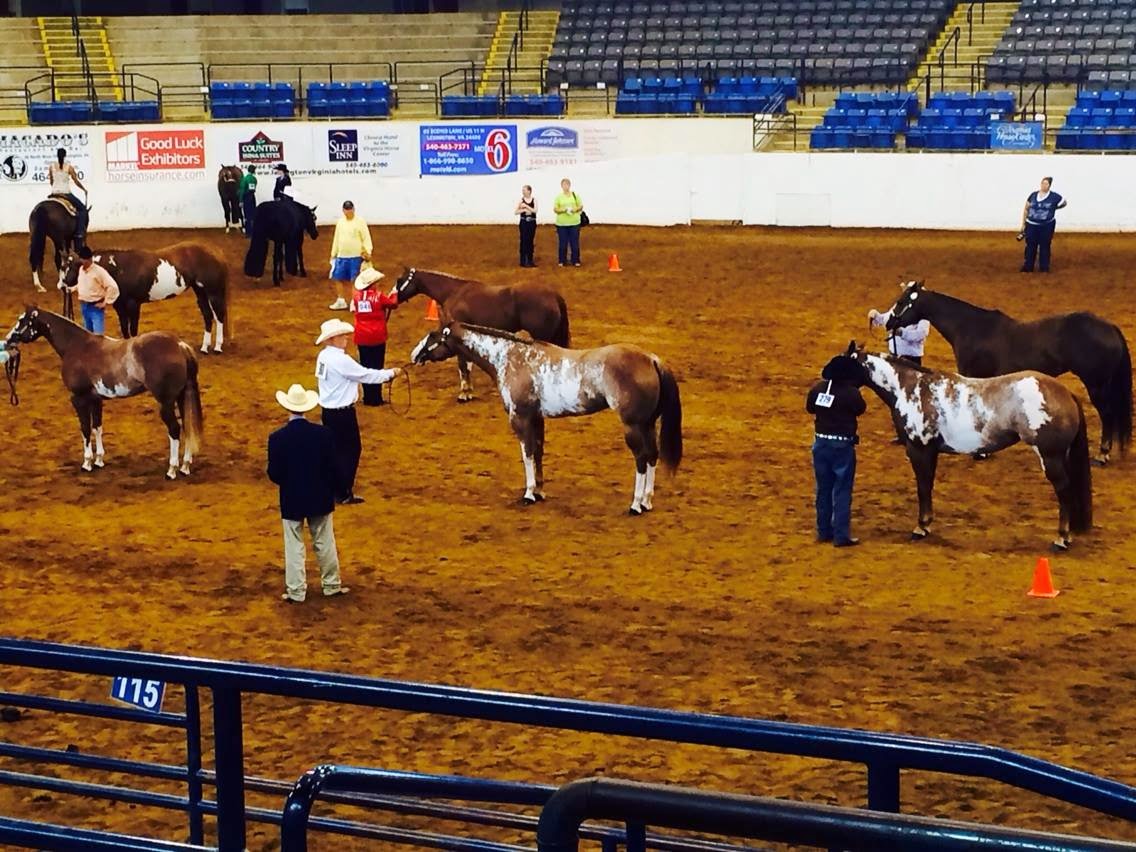
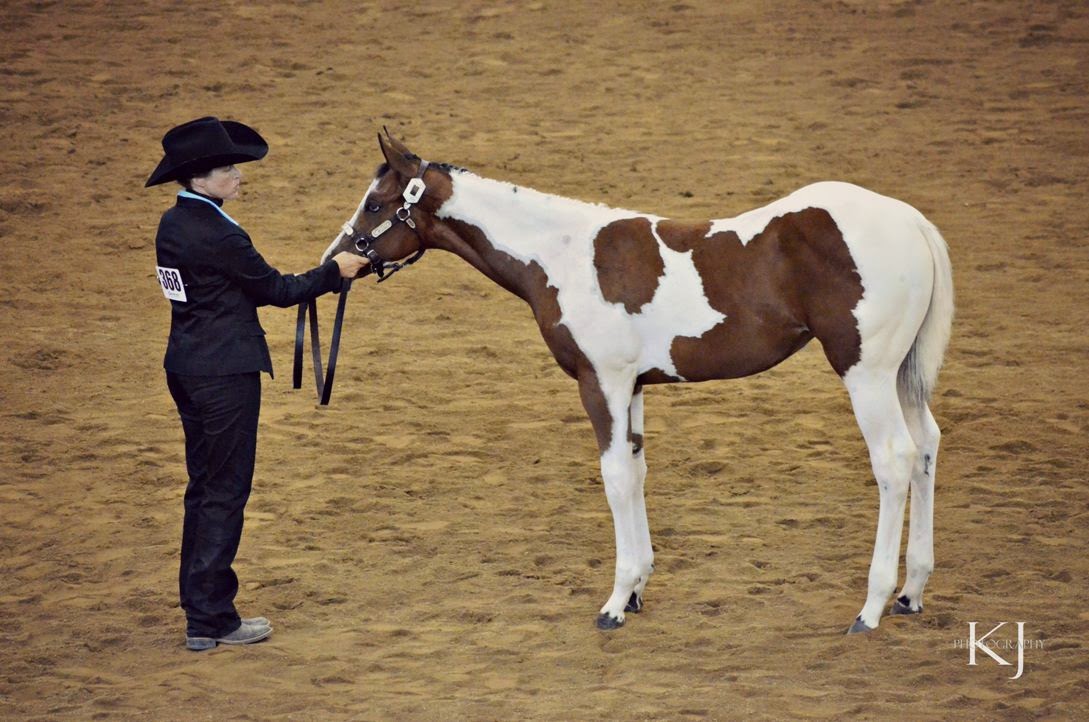
The Virginia Horse Center in Lexington, Va., hosted the Virginia Paint Horse Club’s Color Classic Horse Show and Futurities Sept. 6-7. While a traveling snafu of one of the judges slowed things down a bit on Saturday, a replacement was found until she could arrive. However halter classes didn’t finish until about 2 p.m. in hot and sticky weather, making it a long day for everyone. Below are some photos taken at the event:

GET YOUR HORSE FIX: Events and shows this weekend.

The best thing about summer is horse shows. And if you can’t get out to show on your own horse, they are still a great way to spend the day. The Virginia Horse Center is hosting the Virginia Barrel Classic, Dressage with a View and SBRAA Lee-Jackson Classic (Appaloosas.)and Hear the Beat Horse Show.

Can’t get out to see them live? You can still get your fix online. The Devon Horse Show is streaming live on the USEFnetwork every day. The show schedule can be found here and the USEFnetwork streams the Dixon Oval (Devon’s main arena) live every day. Meanwhile the AQHA’s Redbud Spectacular is streaming live through June 8 on iequine.com. Find the schedule here.

Should we be #AQHA Proud?

AQHA sent out this Facebook post on May 28 at 7 p.m. of a really gorgeous photo. A gleaming bay horse, his mane and forelock falling dramatically before him. Really quite beautiful. Except….. the very thing that has been called abuse in such disciplines as Dressage is being promoted here by the organization that oversees the quarter horse breed.

This horse is pushed to the ultimate in flexion, his chin pushed against his chest. His mouth is open and he has nowhere left to go. The bit appears to be severe with long shanks. And while it is a dramatic photo, AQHA’s promotion of it as part of its #AQHAproud campaign also promotes intimidation as a training technique, which is the very thing they should be protecting the breed from.

In this era when the general public has their eyes on the horse industry, the associations that run our horse shows, make our standards, and promote our breeds should be watchful of also promoting good horsemanship practices. Tennessee Walking horse breeders/exhibitors have recently come under much scrutiny for their training techniques. Horse racing is being more carefully watched by the public, partly due to a resent onslaught of undercover videos by PETA. Many believe AQHA could find themselves in the same boat if some training practices are not curtailed. It’s disappointing to see this image, as beautiful as it is artistically, featured on the AQHA’s page.

Extreme trail indeed

This video is getting attention around the Internet of a horse performing in Extreme Trail without a bridle at the Oregon Trail Center in Eugene, Ore. The horse seen in the video is Sir Rugged Chex’s, aka Checkers, and is shown here with rider Mark Bolender, winning the class by turning in the fastest time.

The Oregon Trail Center duplicates the terrain of the mountains inside its arena using 200 tons of rock, dirt, hand-picked sage brush and trees and even a 20-foot waterfall for their Mountain Trail Show. Many different divisions from youth to advanced are offered on two different trail courses.

Mark Bolender, of Silver Creek Wash., is a leading trainer in Extreme Trail competition.

Cass Ole brought imaginations alive in "The Black Stallion"

He was a National Champion in Arabian Western Pleasure in 1975, National Reserve Champion Arabian Ladies Side Saddle in 1976, and U.S. Top Ten Arabian English Pleasure in both 1975 and 1976. He won more than 50 championships and 20 reserve championships in his seven-year show career and was high point winner of the prestigious King Saud Trophy. But it was his role as Shêtân in “The Black Stallion” that made Arabian stallion Cass Ole an icon.

What horse lover will ever forget the scenes on the beach, watching the gorgeous black Arabian gallop across the white island sand? Who needs Brad Pitt or Johnny Depp as a leading man when there is such a horse to play the leading role? Director Carroll Ballard traveled all over the world looking for the right horse to play “the Black” from Walter Farley’s beloved 1947 book. But it was in Texas, on Farley’s recommendation, that Ballard would find the perfect stallion to bring the story to life. Cass Ole was naturally black, except for a star and white socks. Those were dyed away for the movie. He was also given a weaved-in mane to help him look wilder.And it was his wonderful manners and trainability that sealed his fate as “The Black Stallion.”

Because Cass Ole was such a valuable show horse, he had several stunt doubles to perform the more grueling parts of filming. Cass Ole still completed 80 percent of the filming himself and proved to be quite versatile — able to look wild and furious toward his enemies, yet loving toward Alec. He would also appear in the movies sequel, “The Black Stallion Returns.”  
 After his life as a Hollywood star, Cass Ole returned to the show pen where he continued to win local and regional titles. He was also a successful sire with 123 foals.

Georgian Grande breeders look to history for breed’s inspiration

Georgian Grande stallion

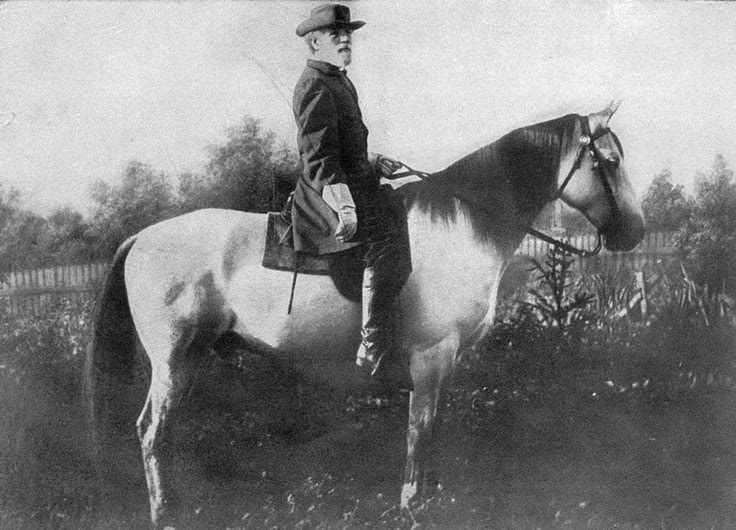
Gen. Robert E. Lee is one of the best known American generals in history. And many also know his horse, Traveller, who he rode into battle. Traveller was a big gray Saddlebred and a great example of the original Saddlebred breed, which were known as large, sensible horses with plenty of bone.

Saddlebreds were often used as cavalry horses during the Civil War. Originally named Jeff Davis, the big gray colt was born near the Blue Sulphur Springs, in what is now West Virginia. As a colt, he took the first prize at the Lewisburg, Virginia fairs in 1859 and 1860. He grew to stand 16 hands high and 1,100 pounds. Lee loved Traveller so much that he kept him after the war ended and the horse went with Lee to Washington College in Lexington, Va.. Both Lee and Traveller are now buried at the college.

Gen. Lee on Traveller

 
Today’s Saddlebreds have been bred to be much lighter and expressive with showy movement for the show ring. They are spirited show horses and have been called the “peacock of the horse world.”

 Now there is a movement to bring back the old breed type by breeding American Saddlebreds with draft horses or the Friesian.  Known as the Georgian Grande, these horses are becoming more popular for a variety of disciplines.

A modern American Saddlebred

The International Georgian Grande Horse Registry was founded in 1994. The IGGHR is a member of the United States Dressage Federation All Breeds Council and also a member of the American Horse Council. It is also fully  recognized by USDF and USEF as  participating breed and Georgian Grandes are eligible to compete for the USEF/ USDF / IGGHR All-Breeds Awards.

Breed standards require that he bloodlines must be a blend of the Saddlebred with Friesian, Clydesdale, Shire, Percheron, or Belgian, or Irish Draught; Registered Drum Horses and Gypsy Vanners (“aka” Gypsy horses”) are acceptable provided they are registered within their own breed and have proof of pedigree. The percentage of saddlebred can be up to 75 percent but never less than 25 percent.

Breeders of the Georgian Grande horses are trying to blend the best of the draft breeds calm temperaments with the beautiful movement of the Saddlebred. The breed is beginning to turn heads and can be found in many equestrian disciplines including jumping, dressage, trail riding and as carriage horses.

Georgian Grande

Black Jack: A feisty spirit that America loved

“Black Jack has been a poignant symbol of our nation’s grief on many occasions over the years. Citizens in mourning felt dignity and purpose conveyed, a simpler yet deeper tribute to the memory of those heroic ‘riders’ who have given so much for our nation. Our people are grateful to Black Jack for helping us bear the burden of sorrow during difficult times.”  — Richard Nixon.

The black riderless horse that paraded into history at JFK’s funeral kind of ended up there on accident. Because he refused to do anything else, the hot and impatient Black Jack became the caparisoned horse.  He was not suitable for riding and threw rider after rider. He also couldn’t be trained to drive.

But despite his ornery attitude, he was gorgeous, with a beautiful head and black coat.  He was moved to the Caisson Platoon at Fort Meyer, Va., in 1952. And frankly, after his first funeral it appeared he wasn’t suitable as the caparisoned horse either. He wouldn’t stand still. He wouldn’t walk, he pranced beside his handler instead. And when the funeral procession would stop, he’d kick out and misbehave. The military apologized for the horse’s behavior, but the family liked his spirit and said it symbolized the life of the one they were honoring. After that day, Black Jack walked (or danced) through 1,000 funerals over 24 years.

The riderless horse, or caparisoned horse, has roots back to Ghengis Khan’s time. The Mongols and Tartars believed that the spirit of a sacrificed horse would travel with its master to the afterlife. The riderless horses are no longer sacrificed, but they still represent a powerful tradition and came to symbolize a rider’s last journey, and the backward boots imply that the warrior is taking one last look at his family.

Perhaps one reason for Black Jack’s continued poor behavior was his ever-changing handlers (military roles changed every 18 months) and because of the solemnity of funeral processions his handler was unable to reprimand or talk to him during the procession. Pfc. Arthur Carlson was Black Jack’s handler for the JFK funeral. He recalled, “He had gotten spooked. He was starting to dance and starting to throw his head. Completely wet with sweat and I said ‘I don’t know what’s wrong with this horse, but I’m in big trouble.'”

“When I started working with Black Jack he was a middle age horse about 16, and calm. Knew his job, did it. No fuss, no bother. Years later I found out when he was a young horse when he first got there he was wild. And barely controllable,” said Carlson. Black Jack had outgrown that wild behavior, until the day of the ceremony. “He had gotten spooked. He was starting to dance and starting to throw his head. Completely wet with sweat and I said I don’t know what’s wrong with this horse but I’m in big trouble,” Carlson recalled.

Read More at: http://www.local15tv.com/shared/news/features/top-stories/stories/wpmi_man-recalls-leading-riderless-horse-kennedy-5975.shtml

“When I started working with Black Jack he was a middle age horse about 16, and calm. Knew his job, did it. No fuss, no bother. Years later I found out when he was a young horse when he first got there he was wild. And barely controllable,” said Carlson. Black Jack had outgrown that wild behavior, until the day of the ceremony. “He had gotten spooked. He was starting to dance and starting to throw his head. Completely wet with sweat and I said I don’t know what’s wrong with this horse but I’m in big trouble,” Carlson recalled.

Read More at: http://www.local15tv.com/shared/news/features/top-stories/stories/wpmi_man-recalls-leading-riderless-horse-kennedy-5975.shtml

Despite his poor behavior, Black Jack was the first choice for important funerals. He also served as the riderless horse forpresidents Herbert Hoover and Lyndon B. Johnson, as well as Gen. Douglas MacArthur.

The coal black Morgan/Quarter Horse cross with a star was the last of the U.S. Army’s Quartermaster-issued horses. Born on Jan. 19, 1947, he carried the U.S. Army brand on his left shoulder and neck.

Black Jack himself died after 29 years of military service on Feb. 6, 1976, and was laid to rest at Fort Myer, Virginia. He was buried with full military honors, only the second horse in U.S. history to receive such an honor (the other being Comanche).

Good I Will Be euthanized

Sandra Morgan‘s good luck and dream of owning multiple World and Congress champion Good I Will Be has come to an end.

Morgan announced Monday, Nov. 11, that the 2004 bay stallion was euthanized after undergoing surgery for a kidney stone at Texas A&M University.

Willy became a bit of a celebrity after being purchased by Morgan at the Rita Crundwell sale. He was the first horse sold at the sale and was bought for $775,000. Morgan had won $35.7 million in the Canadian Lottery in May of 2011.

(Willy’s former owner, Crundwell, was convicted of embezzling about $53 million from the town of Dixon, Ill., where she was the comptroller and treasurer over a 22-year period. Crundwell was one of the top quarter horse breeders with her horses winning 52 world championships.)

After his purchase at the Crundwell sale, Willy posed for hours at the 2012 Quarter Horse Congress as his many adoring fans took photos with the bay stallion. “Before now, people may have thought Willy was inaccessible, but with his new home, ownership and marketing campaign, we want to make sure that everybody knows that he is everybody’s horse,” Stephen Stephens, owner of Dry River Ranch, told GoHorseShow.com in 2012.

 
“He is just eight years-old and he has already sired several futurity champions and we are looking forward to continuing his breeding career,” Stephens said after the sale. “I am blessed to be given the opportunity to stand such a talented stallion.” He was standing at Dry River Ranch for a 2014 stud fee of $2,500.