Georgian Grande breeders look to history for breed’s inspiration

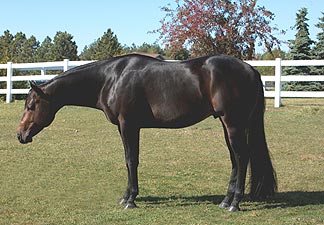
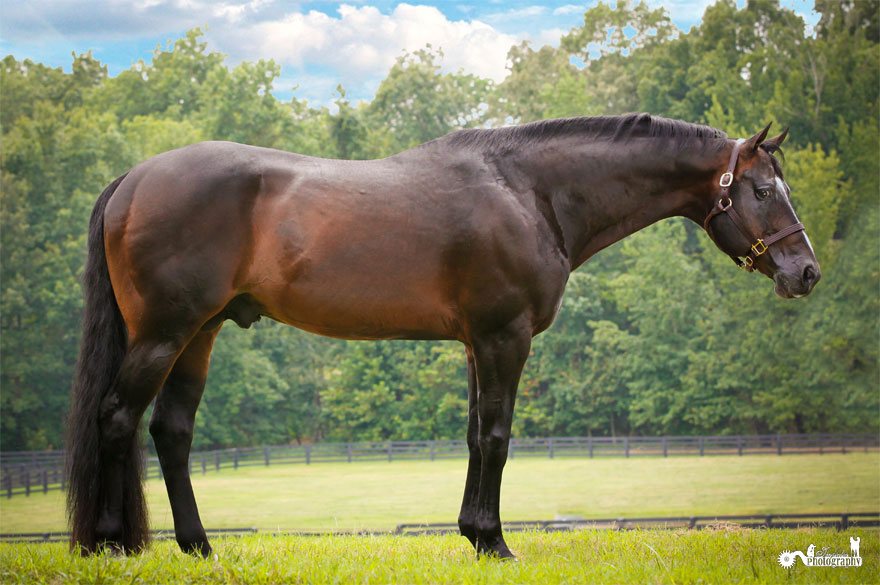
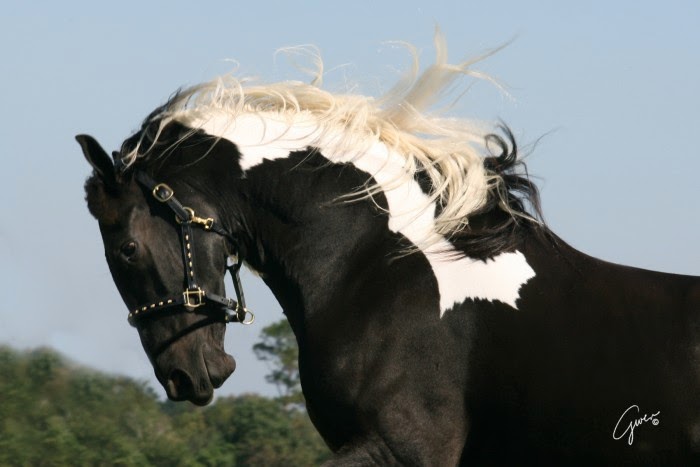
Georgian Grande stallion

Gen. Robert E. Lee is one of the best known American generals in history. And many also know his horse, Traveller, who he rode into battle. Traveller was a big gray Saddlebred and a great example of the original Saddlebred breed, which were known as large, sensible horses with plenty of bone.

Saddlebreds were often used as cavalry horses during the Civil War. Originally named Jeff Davis, the big gray colt was born near the Blue Sulphur Springs, in what is now West Virginia. As a colt, he took the first prize at the Lewisburg, Virginia fairs in 1859 and 1860. He grew to stand 16 hands high and 1,100 pounds. Lee loved Traveller so much that he kept him after the war ended and the horse went with Lee to Washington College in Lexington, Va.. Both Lee and Traveller are now buried at the college.
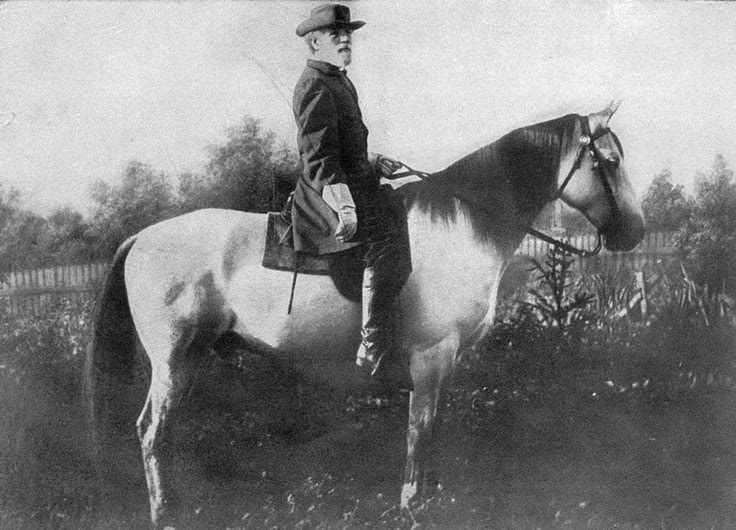
Gen. Lee on Traveller

 
Today’s Saddlebreds have been bred to be much lighter and expressive with showy movement for the show ring. They are spirited show horses and have been called the “peacock of the horse world.”

 Now there is a movement to bring back the old breed type by breeding American Saddlebreds with draft horses or the Friesian.  Known as the Georgian Grande, these horses are becoming more popular for a variety of disciplines.

A modern American Saddlebred

The International Georgian Grande Horse Registry was founded in 1994. The IGGHR is a member of the United States Dressage Federation All Breeds Council and also a member of the American Horse Council. It is also fully  recognized by USDF and USEF as  participating breed and Georgian Grandes are eligible to compete for the USEF/ USDF / IGGHR All-Breeds Awards.

Breed standards require that he bloodlines must be a blend of the Saddlebred with Friesian, Clydesdale, Shire, Percheron, or Belgian, or Irish Draught; Registered Drum Horses and Gypsy Vanners (“aka” Gypsy horses”) are acceptable provided they are registered within their own breed and have proof of pedigree. The percentage of saddlebred can be up to 75 percent but never less than 25 percent.

Breeders of the Georgian Grande horses are trying to blend the best of the draft breeds calm temperaments with the beautiful movement of the Saddlebred. The breed is beginning to turn heads and can be found in many equestrian disciplines including jumping, dressage, trail riding and as carriage horses.

Georgian Grande

Black Jack: A feisty spirit that America loved

“Black Jack has been a poignant symbol of our nation’s grief on many occasions over the years. Citizens in mourning felt dignity and purpose conveyed, a simpler yet deeper tribute to the memory of those heroic ‘riders’ who have given so much for our nation. Our people are grateful to Black Jack for helping us bear the burden of sorrow during difficult times.”  — Richard Nixon.

The black riderless horse that paraded into history at JFK’s funeral kind of ended up there on accident. Because he refused to do anything else, the hot and impatient Black Jack became the caparisoned horse.  He was not suitable for riding and threw rider after rider. He also couldn’t be trained to drive.

But despite his ornery attitude, he was gorgeous, with a beautiful head and black coat.  He was moved to the Caisson Platoon at Fort Meyer, Va., in 1952. And frankly, after his first funeral it appeared he wasn’t suitable as the caparisoned horse either. He wouldn’t stand still. He wouldn’t walk, he pranced beside his handler instead. And when the funeral procession would stop, he’d kick out and misbehave. The military apologized for the horse’s behavior, but the family liked his spirit and said it symbolized the life of the one they were honoring. After that day, Black Jack walked (or danced) through 1,000 funerals over 24 years.

The riderless horse, or caparisoned horse, has roots back to Ghengis Khan’s time. The Mongols and Tartars believed that the spirit of a sacrificed horse would travel with its master to the afterlife. The riderless horses are no longer sacrificed, but they still represent a powerful tradition and came to symbolize a rider’s last journey, and the backward boots imply that the warrior is taking one last look at his family.

Perhaps one reason for Black Jack’s continued poor behavior was his ever-changing handlers (military roles changed every 18 months) and because of the solemnity of funeral processions his handler was unable to reprimand or talk to him during the procession. Pfc. Arthur Carlson was Black Jack’s handler for the JFK funeral. He recalled, “He had gotten spooked. He was starting to dance and starting to throw his head. Completely wet with sweat and I said ‘I don’t know what’s wrong with this horse, but I’m in big trouble.'”

“When I started working with Black Jack he was a middle age horse about 16, and calm. Knew his job, did it. No fuss, no bother. Years later I found out when he was a young horse when he first got there he was wild. And barely controllable,” said Carlson. Black Jack had outgrown that wild behavior, until the day of the ceremony. “He had gotten spooked. He was starting to dance and starting to throw his head. Completely wet with sweat and I said I don’t know what’s wrong with this horse but I’m in big trouble,” Carlson recalled.

Read More at: http://www.local15tv.com/shared/news/features/top-stories/stories/wpmi_man-recalls-leading-riderless-horse-kennedy-5975.shtml

“When I started working with Black Jack he was a middle age horse about 16, and calm. Knew his job, did it. No fuss, no bother. Years later I found out when he was a young horse when he first got there he was wild. And barely controllable,” said Carlson. Black Jack had outgrown that wild behavior, until the day of the ceremony. “He had gotten spooked. He was starting to dance and starting to throw his head. Completely wet with sweat and I said I don’t know what’s wrong with this horse but I’m in big trouble,” Carlson recalled.

Read More at: http://www.local15tv.com/shared/news/features/top-stories/stories/wpmi_man-recalls-leading-riderless-horse-kennedy-5975.shtml

Despite his poor behavior, Black Jack was the first choice for important funerals. He also served as the riderless horse forpresidents Herbert Hoover and Lyndon B. Johnson, as well as Gen. Douglas MacArthur.

The coal black Morgan/Quarter Horse cross with a star was the last of the U.S. Army’s Quartermaster-issued horses. Born on Jan. 19, 1947, he carried the U.S. Army brand on his left shoulder and neck.

Black Jack himself died after 29 years of military service on Feb. 6, 1976, and was laid to rest at Fort Myer, Virginia. He was buried with full military honors, only the second horse in U.S. history to receive such an honor (the other being Comanche).

Good I Will Be euthanized

Sandra Morgan‘s good luck and dream of owning multiple World and Congress champion Good I Will Be has come to an end.

Morgan announced Monday, Nov. 11, that the 2004 bay stallion was euthanized after undergoing surgery for a kidney stone at Texas A&M University.

Willy became a bit of a celebrity after being purchased by Morgan at the Rita Crundwell sale. He was the first horse sold at the sale and was bought for $775,000. Morgan had won $35.7 million in the Canadian Lottery in May of 2011.

(Willy’s former owner, Crundwell, was convicted of embezzling about $53 million from the town of Dixon, Ill., where she was the comptroller and treasurer over a 22-year period. Crundwell was one of the top quarter horse breeders with her horses winning 52 world championships.)

After his purchase at the Crundwell sale, Willy posed for hours at the 2012 Quarter Horse Congress as his many adoring fans took photos with the bay stallion. “Before now, people may have thought Willy was inaccessible, but with his new home, ownership and marketing campaign, we want to make sure that everybody knows that he is everybody’s horse,” Stephen Stephens, owner of Dry River Ranch, told GoHorseShow.com in 2012.

 
“He is just eight years-old and he has already sired several futurity champions and we are looking forward to continuing his breeding career,” Stephens said after the sale. “I am blessed to be given the opportunity to stand such a talented stallion.” He was standing at Dry River Ranch for a 2014 stud fee of $2,500.

Blanketing hoax making its rounds again

As a journalist, one of my Facebook pet peeves are the numerous viral false posts that are shared on my news feed. I can’t help but head right over to snopes.com to verify the information. But this week I was the one who was helping spread a false study on horse blanketing.

Titled “CSU Blanketing Study” it backed all my own completely unscientific beliefs about blanketing horses, or more accurately, why you shouldn’t blanket horses.  It reads “Horses have the ability to loft and lower their coats to 17 different levels, so it’s like exchanging 17 different thermal weights of blankets off and on them all day and night, depending on what they need,” and, “Only three things make the ‘self-blanketing’ process not work: blanketing, clipping and wind. Not even snow or rain stops their own thermostats from doing the job.” Yes! I knew it! And finally a study was showing it was more than a horseman’s hunch!

The only problem was, there never was such a study at Colorado State University. The fake claims seem to start making the Internet rounds every fall, but the university says it has never done such a study.

So what is the prevailing beliefs on blanketing horses? It seems to depend who you ask and on your individual circumstances. Older, weak or ill horses; horses that are clipped; very extreme weather or lack of shelter; a move from a warmer climate to a cooler climate; and of course if the horse is shivering are all reasons that blanketing is recommended.

Horse-rider trust key in Medal win

Several years ago, Animal Planet did a reality show “Horse Power: Road to the Maclay” that I became obsessed with. The journey of a group of teens from around the country trying to win the most prestigious hunt-seat equitation championship in the world was fascinating. On Sunday, Oct. 13, this year’s competitors took to the arena in Harrisburg to go after the Medal Finals at the Pennsylvania National Horse Show. While we didn’t get to follow them for months to see the obstacles they faced to be in that arena Sunday night, they undoubtedly overcame many, regardless of talent, money or training.

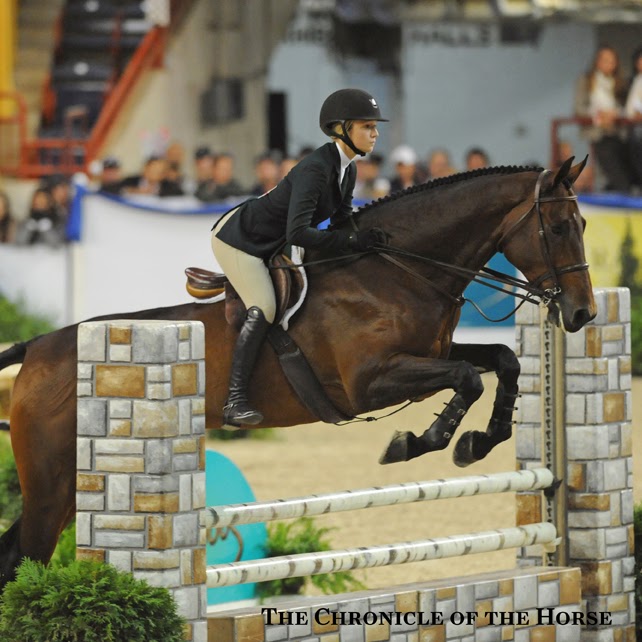
Lillie Keenan, who was crowned champion Sunday, admitted to the break in her confidence leading up to the Harrisburg show. Keenan is one of America’s top junior riders, and has been for many years. She made history at the 2007 USEF Pony Finals when she won all three regular pony hunter divisions. In 2008, she won five out of the six possible championships and was reserve champion in the medal. She has been in the top ten at the Maclay Finals twice.So what would shake such an accomplished rider’s trust in her horse and her own ability?

At the Platinum Performance/USEF Show Jumping Talent Search Finals-East in New Jersey, where she was leading the competition after two rounds, Keenan’s ride, Clearway, stopped twice at a simple stone wall oxer, eliminating her.

“Horses are horses. I think it was a wake-up call that they’re not robots; they’re animals,” Keenan said, who admits she brought a backup horse with her to Harrisburg. She said that in the first round of the Medal Finals, she wasn’t riding her best. “I wasn’t trusting my horse as much as I should have and I wasn’t confident in myself. But my horse didn’t put a foot wrong all week, so I gradually began to trust him again and ride him like his old self.”

Sunday night the final six riders were put through a very difficult test over jumps, without their irons. Given to them in the arena, it was repeated three times before the first rider took to the course.  Keenan’s carefully thought out ride that gave herself the time and room to do the required movements between jumps secured her the win.

Michael Hughes finished in second and Charlotte Jacobs, who had been leading the competition but was unable to complete the two lead changes required in the final test, dropped to third.

Macs Good and Plenty offered at auction

Macs Good and Plenty

AQHA stallion Macs Good and Plenty will be offered for sale in the Quarter Horse Congress Super Sale on Sunday, Oct. 20 in Columbus, Ohio.

The 1997 brown son of Zippos Mr Good Bar (x Macs Debutante) is a Congress Champion and Equistat Leading Pleasure Sire. He has NSBA $13,991.79. He is the sire of NSBA, AQHA,PHBA, PtHA & Buckskin World Champions & Congress Champions.

Macs Good and Plenty’s stablemate and son, Ty, by Misstig Rebel (daughter of Iron Rebel), and the sire of AQHA point earners, NSBA money earners and multiple Futurity champions is also being offered in the sale. Ty was diagnosed with EPM in 2006 just before he was ready to show at Congress in the maiden 2 YO Master’s class. His owners say he has made a full recovery and is now not affected.

Ty

A few of Macs Good and Plenty’s other offspring will also be offered in the sale. To see a sale preview, visit the Congress Super Sale Preview of Entries. ready to show at the 2006 Congress in the maiden 2 YO Master’s class. He has made a remarkable FULL recovery and does not affect him in any way today.

Last Detail moves to Hanes Performance Horses

Legendary AQHA hunter stallion Last Detail has moved to Hanes Performance Horses and into semi-retirement. The Shelbyville, Tenn., farm is also the home of AQHA legend <a href="http://

” target=”_blank”>An Awesome Mister, who moved there to live out his years last year.

Last Detail, which is owned by Larry and Linda Whitaker and is now 22 years old, will stand to just a few select outside mares in 2014, and Taylor Hanes said he will be mainly breeding his own mares to the stallion.
  
Last Detail’s Show and Sire Record:

  • World Champion Junior Hunter Under Saddle
  • Congress Champion Junior Hunter Under Saddle
  • AQHA All Time Leading Sire Of Hunter Under Saddle point earners (27,910)
  • AQHA All Time Leading Sire Of Open Hunter Under Saddle point earners (4,910)
  • AQHA All Time Leading Sire Of Amateur Hunter Under Saddle point earners (4,361)
  • AQHA All Time Leading Sire Of Youth Hunter Under Saddle point earners (3,405)
  • AQHA All Time Leading Sire Hunter Under Saddle Incentive Fund Earnings ($444,142)
  • Equi-Stat All Time Leading money earning sire of Hunter Under Saddle horses. ($508,238) 
  • NSBA Hall Of Fame Stallion

Colonial Nationals blazes through the Va. Horse Center

Barrel racing came to the Virginia Horse Center over the weekend. The Colonial Nationals drew about 1,000 horses to the facility and the arenas were buzzing with both exhibitors and spectators to watch who would be fastest around three barrels. The top horses were posting runs just a split hair more than 15 seconds on a cool weekend by August in Virginia standards.

Jury bucks horsemen’s advice, says cloned horses should be allowed in AQHA

Clones at Texas A&M

A federal court jury said Tuesday that the AQHA should allow registration of cloned horses, possibly clearing the way for those horses to be shown and raced in AQHA-sanctioned events.

The jury in U.S. District Court for the Northern District of Texas in Amarillo found in favor of rancher Jason Abraham of Canadian, Texas, and veterinarian Gregg Veneklasen of Amarillo, saying the association violated the federal Sherman Antitrust Act and the Texas Free Enterprise and Antitrust Act.

 
The verdict does not mean cloned horses automatically get registered. But the plaintiffs’ lawyers said they hoped the AQHA would allow registration without a court hearing on a permanent injunction.

The plaintiffs had asked for $2 million to $5 million in damages, but the jury provided no money award.

Abraham and Veneklasen argued the association held an illegal monopoly in quarter horse racing.
 
Abraham and Veneklasen, both members of the association, had argued that cloning would strengthen the quarter horse breed by re-introducing champions who are deceased or unable to breed, and could help reduce disease by enabling breeders to “silence detrimental genes.”
 
But opponents of cloning within the association countered by saying that natural breeding produced the most desirable traits and that cloning undermines the progression of the breed. They also pointed to the chance of growth defects displayed in other cloned animals.
 
Cloning isn’t easy, it isn’t cheap, and there are no guarantees that the clone will match the talent of the original. The first successfully cloned horse, a mare called Prometea, was born in 2003. Today, there are only a few hundred equine clones, created mainly for breeding, not competing. The cloning process can cost more than a $150,000. With cloning, the original horse can travel and compete (and be gelded for better performance), while its copy becomes a full-time foal-making machine.
 
Pure Tailor Fit
One example of quarter horse cloning is Pure Taylor Fit, a young copy of two-time world champion racehorse Tailor Fit – a gelding. According to the website Taylor Fit Barrel Horses, Pure Taylor Fit began standing at stud in 2011.
“In my opinion, this is a perfect example of greed by two people taking advantage of a legitimate association with legitimate rules that they want to break,” Carol Harris, who has been a member of the AQHA for more than 60 years, and bred the legendary AQHA stallion Rugged Lark, told the Ocala Star Banner. ““We could lose the DNA trail, and that could be really dangerous,” Harris said of using cloned horses for breeding purposes. 
“If I cloned Rugged Lark, it wouldn’t be Rugged Lark. It might look like him, but Rugged Lark became who he was because of the way he was raised; what we did with him every day. I couldn’t even begin to do the things we did. I don’t even remember half of what we did,” she said.

Other equine champions that have been cloned include Pan American Games gold-medalist Sapphire, whose genetic twin is called Saphir, and Olympic dressage horse Rusty, whose genetic twins are now yearlings.
The two yearlings are being raised by cloning specialist Cryozootech to become stallions.
In July 2012 the FEI lifted a ban on cloned horses and their progeny competing in the Olympic Games.  

In analyzing cloned horses, the federation determined that the clones were only 98 percent copies of the originals. The FEI has been careful to emphasize that cloning is a breeding technique only—they will never allow processes that might select certain genes over others in an attempt to create a superhorse.
 
The Jockey Club, which registers thoroughbreds in North America does not allow cloning or any type of assisted breeding, including artificial insemination.
“Anybody can clone Secretariat,” Dan Rosenberg of the Three Chimneys thoroughbred farm in Lexington, Kentucky, told Yahoo! Sports in 2012. “Not everyone can breed Secretariat.”

Reckless, equine war hero, honored with monument

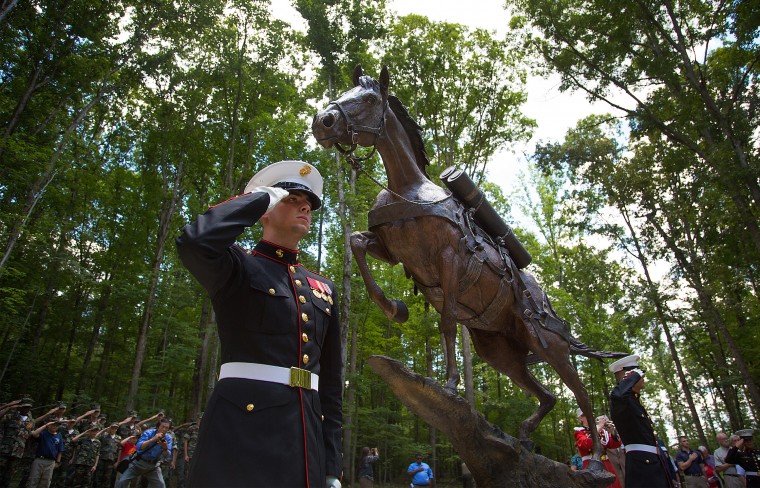
Sgt. Reckless, a scrawny 14-hand mare who served in the Korean War and earned two Purple Hearts,was honored with a monument Friday, July 26, at Virginia’s National Museum of the Marine Corps in time to commemorate the 60th anniversary of the war’s end. 

The horse earned the rank of Staff Sgt. after being purchased  in October 1952 for $250 from a Korean boy who sold her in order to buy an artificial leg for his sister who had lost hers to a land mine. She had a Korean name, but the Americans had trouble pronouncing it, so they named her after the platoon’s radio call sign.

The horse bonded quickly with the Marines. She’d stick her nose in the tent where Marines were living and lumber in, said John Newsom, 77. “She’d eat almost anything,” Newsom said. “She loved Tootsie Rolls.”

The Marines also gave her some of their monthly beer allotment. In return, Reckless carried ammunition to the front lines and saved Marines’ lives.She carried her burdens without a handler, going back and forth by memory.

She earned her stripes, which were pinned to her horse blanket, after the battle for Vegas Hill, a firefight that raged for three days.

That day, Reckless made 51 trips up and down the hill, carrying four tons of shells to the front lines, and carrying wounded and dead Marines down from the battlefield.
At one time, she shielded four Marines on the trail. She was wounded by shrapnel not once, but twice that day. 

 The Marines taught her how to duck under barbed wire and how to lie flat if caught under fire in the open.
After the war, the Marines managed to bring Reckless to the United States, where she became a minor celebrity. She appeared on television, and magazine profiles were written about her.

“She wasn’t a horse, she was a Marine,” said Robin Hutton, whose book, “Sgt. Reckless, America’s War Horse,” will be published later this year. “When the Marines got her, they became her herd. She bonded with them and would do anything for them. She’d follow them anywhere and everywhere.”
The legend of Reckless spread, earning her a place among other four-legged legends like Lassie and Rin Tin Tin. But with time, that legend faded.

Reckless and Fearless

Reckless gave birth to three colts — named Fearless, Dauntless and Chesty — and a filly that died one month later.