Last Detail moves to Hanes Performance Horses

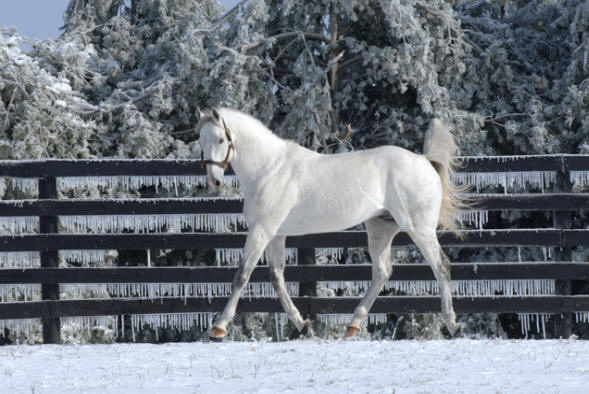
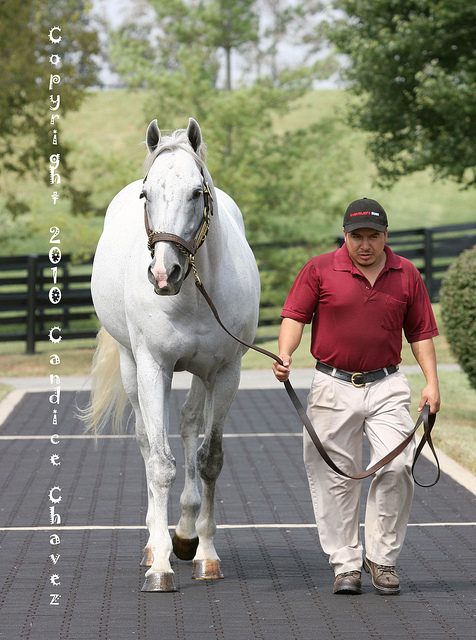
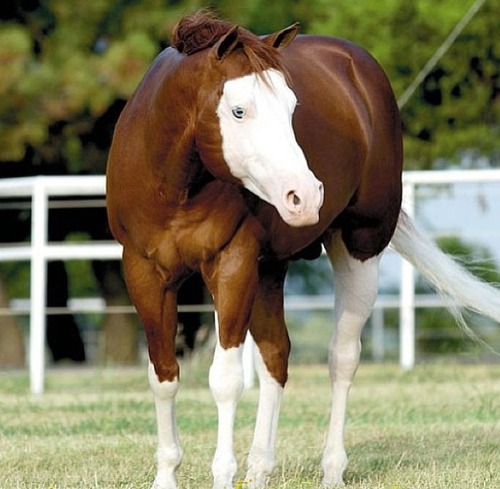
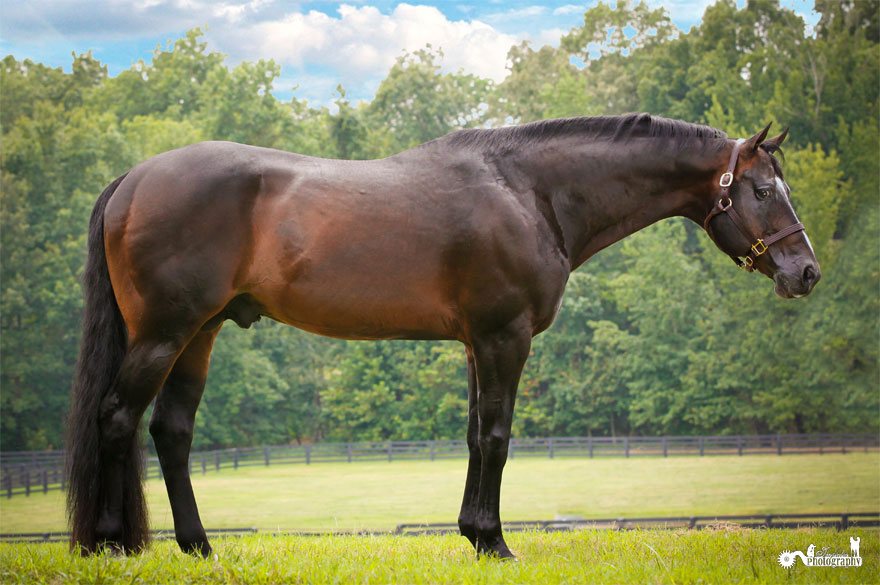
Legendary AQHA hunter stallion Last Detail has moved to Hanes Performance Horses and into semi-retirement. The Shelbyville, Tenn., farm is also the home of AQHA legend <a href="http://

” target=”_blank”>An Awesome Mister, who moved there to live out his years last year.

Last Detail, which is owned by Larry and Linda Whitaker and is now 22 years old, will stand to just a few select outside mares in 2014, and Taylor Hanes said he will be mainly breeding his own mares to the stallion.
  
Last Detail’s Show and Sire Record:

  • World Champion Junior Hunter Under Saddle
  • Congress Champion Junior Hunter Under Saddle
  • AQHA All Time Leading Sire Of Hunter Under Saddle point earners (27,910)
  • AQHA All Time Leading Sire Of Open Hunter Under Saddle point earners (4,910)
  • AQHA All Time Leading Sire Of Amateur Hunter Under Saddle point earners (4,361)
  • AQHA All Time Leading Sire Of Youth Hunter Under Saddle point earners (3,405)
  • AQHA All Time Leading Sire Hunter Under Saddle Incentive Fund Earnings ($444,142)
  • Equi-Stat All Time Leading money earning sire of Hunter Under Saddle horses. ($508,238) 
  • NSBA Hall Of Fame Stallion

Colonial Nationals blazes through the Va. Horse Center

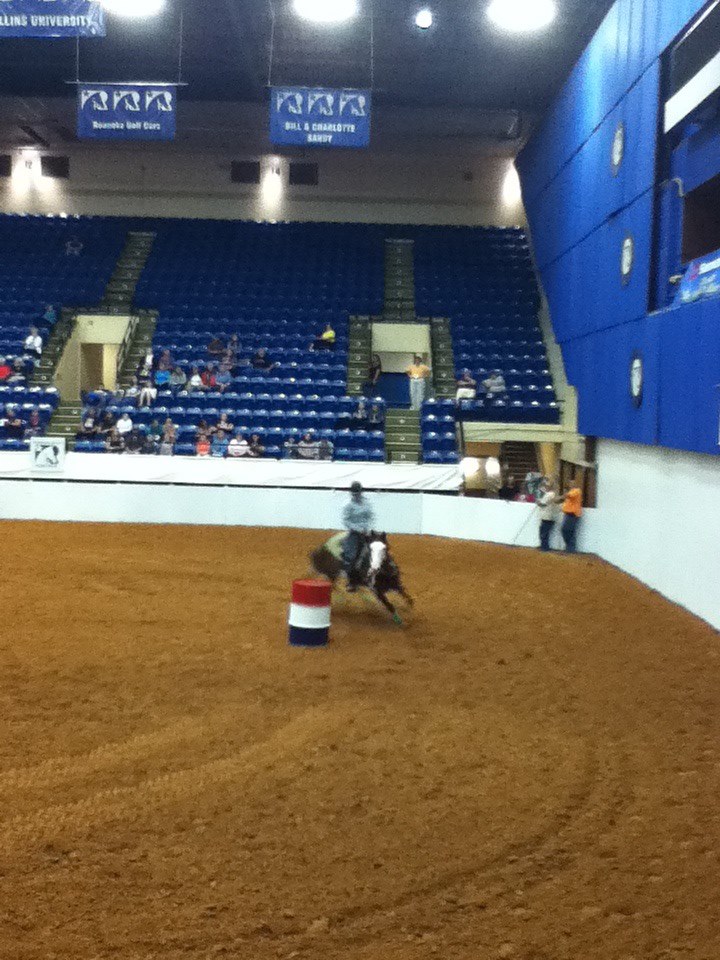
Barrel racing came to the Virginia Horse Center over the weekend. The Colonial Nationals drew about 1,000 horses to the facility and the arenas were buzzing with both exhibitors and spectators to watch who would be fastest around three barrels. The top horses were posting runs just a split hair more than 15 seconds on a cool weekend by August in Virginia standards.

Jury bucks horsemen’s advice, says cloned horses should be allowed in AQHA

Clones at Texas A&M

A federal court jury said Tuesday that the AQHA should allow registration of cloned horses, possibly clearing the way for those horses to be shown and raced in AQHA-sanctioned events.

The jury in U.S. District Court for the Northern District of Texas in Amarillo found in favor of rancher Jason Abraham of Canadian, Texas, and veterinarian Gregg Veneklasen of Amarillo, saying the association violated the federal Sherman Antitrust Act and the Texas Free Enterprise and Antitrust Act.

 
The verdict does not mean cloned horses automatically get registered. But the plaintiffs’ lawyers said they hoped the AQHA would allow registration without a court hearing on a permanent injunction.

The plaintiffs had asked for $2 million to $5 million in damages, but the jury provided no money award.

Abraham and Veneklasen argued the association held an illegal monopoly in quarter horse racing.
 
Abraham and Veneklasen, both members of the association, had argued that cloning would strengthen the quarter horse breed by re-introducing champions who are deceased or unable to breed, and could help reduce disease by enabling breeders to “silence detrimental genes.”
 
But opponents of cloning within the association countered by saying that natural breeding produced the most desirable traits and that cloning undermines the progression of the breed. They also pointed to the chance of growth defects displayed in other cloned animals.
 
Cloning isn’t easy, it isn’t cheap, and there are no guarantees that the clone will match the talent of the original. The first successfully cloned horse, a mare called Prometea, was born in 2003. Today, there are only a few hundred equine clones, created mainly for breeding, not competing. The cloning process can cost more than a $150,000. With cloning, the original horse can travel and compete (and be gelded for better performance), while its copy becomes a full-time foal-making machine.
 
Pure Tailor Fit
One example of quarter horse cloning is Pure Taylor Fit, a young copy of two-time world champion racehorse Tailor Fit – a gelding. According to the website Taylor Fit Barrel Horses, Pure Taylor Fit began standing at stud in 2011.
“In my opinion, this is a perfect example of greed by two people taking advantage of a legitimate association with legitimate rules that they want to break,” Carol Harris, who has been a member of the AQHA for more than 60 years, and bred the legendary AQHA stallion Rugged Lark, told the Ocala Star Banner. ““We could lose the DNA trail, and that could be really dangerous,” Harris said of using cloned horses for breeding purposes. 
“If I cloned Rugged Lark, it wouldn’t be Rugged Lark. It might look like him, but Rugged Lark became who he was because of the way he was raised; what we did with him every day. I couldn’t even begin to do the things we did. I don’t even remember half of what we did,” she said.

Other equine champions that have been cloned include Pan American Games gold-medalist Sapphire, whose genetic twin is called Saphir, and Olympic dressage horse Rusty, whose genetic twins are now yearlings.
The two yearlings are being raised by cloning specialist Cryozootech to become stallions.
In July 2012 the FEI lifted a ban on cloned horses and their progeny competing in the Olympic Games.  

In analyzing cloned horses, the federation determined that the clones were only 98 percent copies of the originals. The FEI has been careful to emphasize that cloning is a breeding technique only—they will never allow processes that might select certain genes over others in an attempt to create a superhorse.
 
The Jockey Club, which registers thoroughbreds in North America does not allow cloning or any type of assisted breeding, including artificial insemination.
“Anybody can clone Secretariat,” Dan Rosenberg of the Three Chimneys thoroughbred farm in Lexington, Kentucky, told Yahoo! Sports in 2012. “Not everyone can breed Secretariat.”

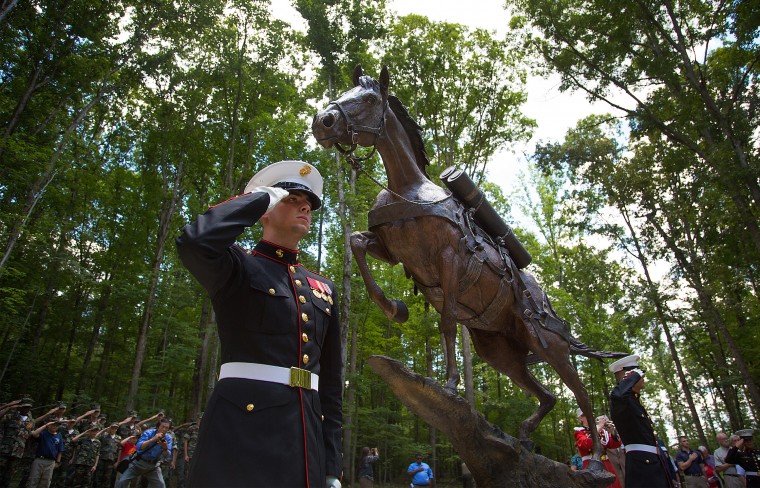
Reckless, equine war hero, honored with monument

Sgt. Reckless, a scrawny 14-hand mare who served in the Korean War and earned two Purple Hearts,was honored with a monument Friday, July 26, at Virginia’s National Museum of the Marine Corps in time to commemorate the 60th anniversary of the war’s end. 

The horse earned the rank of Staff Sgt. after being purchased  in October 1952 for $250 from a Korean boy who sold her in order to buy an artificial leg for his sister who had lost hers to a land mine. She had a Korean name, but the Americans had trouble pronouncing it, so they named her after the platoon’s radio call sign.

The horse bonded quickly with the Marines. She’d stick her nose in the tent where Marines were living and lumber in, said John Newsom, 77. “She’d eat almost anything,” Newsom said. “She loved Tootsie Rolls.”

The Marines also gave her some of their monthly beer allotment. In return, Reckless carried ammunition to the front lines and saved Marines’ lives.She carried her burdens without a handler, going back and forth by memory.

She earned her stripes, which were pinned to her horse blanket, after the battle for Vegas Hill, a firefight that raged for three days.

That day, Reckless made 51 trips up and down the hill, carrying four tons of shells to the front lines, and carrying wounded and dead Marines down from the battlefield.
At one time, she shielded four Marines on the trail. She was wounded by shrapnel not once, but twice that day. 

 The Marines taught her how to duck under barbed wire and how to lie flat if caught under fire in the open.
After the war, the Marines managed to bring Reckless to the United States, where she became a minor celebrity. She appeared on television, and magazine profiles were written about her.

“She wasn’t a horse, she was a Marine,” said Robin Hutton, whose book, “Sgt. Reckless, America’s War Horse,” will be published later this year. “When the Marines got her, they became her herd. She bonded with them and would do anything for them. She’d follow them anywhere and everywhere.”
The legend of Reckless spread, earning her a place among other four-legged legends like Lassie and Rin Tin Tin. But with time, that legend faded.

Reckless and Fearless

Reckless gave birth to three colts — named Fearless, Dauntless and Chesty — and a filly that died one month later.

Great racehorse, sire Unbridled Song euthanized

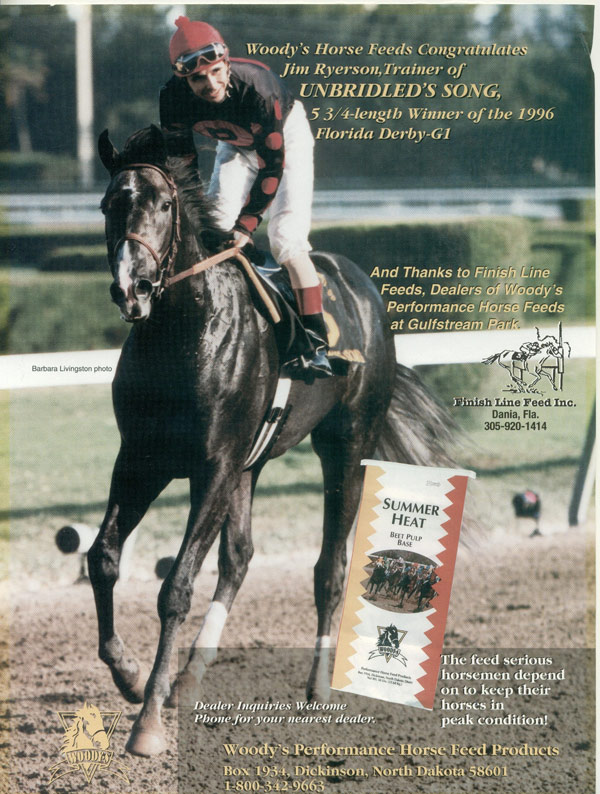
Unbridled’s Song, the son of 1990 Kentucky Derby winner Unbridled who went on to capture a Breeders’ Cup race and become a prolific sire, died Friday. He was 20.

Taylor Made Stallions, where the horse stood his entire career, said in a statement that the stallion began showing acute neurological symptoms Thursday and was taken to Rood and Riddle Equine Hospital in Lexington, Ky. An MRI showed a large and inoperable mass in his sinus cavities and around the optic nerves. He was euthanized Friday, July 26.

“Unbridled’s Song was one of those great horses,” Taylor Made President and CEO Duncan Taylor said.

“He had it all — looks, pedigree, speed, and presence.
Our team loved him from the beginning.”

Unbridled’s Song was a $200,000 purchase at the 1994 Fasig-Tipton Saratoga selected yearling sale by Ernie Paragallo’s Paraneck Stable. He was then sold as a 2-year-old for $1.4 million at the Barretts March sale of 2-year-olds in training, with Taylor Made as agent, only to be bought back by Paragallo when sale buyer Hiroshi Fujita refused the sale after stating that his veterinarian found evidence of ankle bone chips.

Among Unbridled’s Song’s 100 stakes winners are 45 Graded stakes winners and 15 Grade 1 winners, including siring at least one Grade 1 winner for 12 straight years. He has three Breeders’ Cup winners, including 2010 Breeders’ Cup Ladies’ Classic (G1) victress Unrivaled Belle, 2001 Breeders’ Cup Distaff (G1) winner Unbridled Elaine, and 2008 Breeders’ Cup Juvenile (G1) winner Midshipman, the Eclipse Champion 2-Year-Old Colt that year. – See more at: http://www.taylormadestallions.com/articles/three-time-g1-winner-leading-sire-unbridled%E2%80%99s-song-euthanized.html#sthash.ni7v7SXc.dpuf

Among Unbridled’s Song’s 100 stakes winners are 45 Graded stakes winners and 15 Grade 1 winners, including siring at least one Grade 1 winner for 12 straight years. He has three Breeders’ Cup winners, including 2010 Breeders’ Cup Ladies’ Classic (G1) victress Unrivaled Belle, 2001 Breeders’ Cup Distaff (G1) winner Unbridled Elaine, and 2008 Breeders’ Cup Juvenile (G1) winner Midshipman, the Eclipse Champion 2-Year-Old Colt that year. – See more at: http://www.taylormadestallions.com/articles/three-time-g1-winner-leading-sire-unbridled%E2%80%99s-song-euthanized.html#sthash.ni7v7SXc.dpuf

As a 2-year-old, Unbridled’s Song won the Breeders’ Cup Juvenile. The next year, he won the Florida Derby and Wood Memorial. He was the 7-2 favorite in the 1996 Kentucky Derby but finished fifth while another Unbridled colt, Grindstone, took the roses. Unbridled’s Song’s career ended prematurely in 1997, when he suffered a broken cannon bone while training for the Donn Handicap.

Unbridled’s Song earned $1,311,800 before retiring to stud in 1997. He had recently completed the 2013 breeding season. He last stood for an advertised fee of $60,000. He sired 730 winners from more than 1,000 starters, the Taylor Made Stallions said.

His progeny are led by U.S. champion Midshipman, Canadian champion Embur’s Song, Breeders’ Cup Distaff/Ladies’ Classic winners Unrivaled Belle, and Unbridled Elaine. He also sired multiple Grade 1 winners Octave, Splendid Blended, Thorn Song, and Zensational, as well as 2008 Kentucky Derby runner-up Eight Belles and 2009 Belmont Stakes runner-up Dunkirk.

Colonels Smoking Gun, "Gunner," euthanized July 8

The reining industry lost a legendary performer and sire on July 8 when Colonels Smoking Gun, known worldwide simply as “Gunner,” lost his battle with laminitis. The National Reining Horse Association Hall of Fame inductee and $5 Million Sire was put down after spending a week at Equine Medical Associates in Pilot Point, Texas.

Tim and Colleen McQuay have owned Gunner since 2005. Colleen said, “Gunner was a sweet happy horse, and when I look at all he has given us I can only be grateful for the time we shared with him.  Losing him leaves another hole in our hearts.”

He will be buried next to Hollywood Dun It on the McQuay’s farm.

Watch a video of Gunner performing on YouTube

Photos from June 19’s afternoon classes at the Roanoke Valley Horse Show

The Roanoke Valley Horse Show in Salem, Va., is often known for the classes that take place after 6 p.m. in the Coliseum that require tickets to get in the door to see. But there’s a lot more going on throughout the day that can be attended for free. Here’s some photos from Tuesday, June 19, as the show kicked into high gear.

Later in the evening on Tuesday, a storm would hit the showgrounds, ripping down one of the stable tents and causing flooding on the grounds. See a story about the damage here.

Some events were postponed after the storm, but things were back underway again Wednesday morning after volunteers worked through the night to get things ready for the next day.

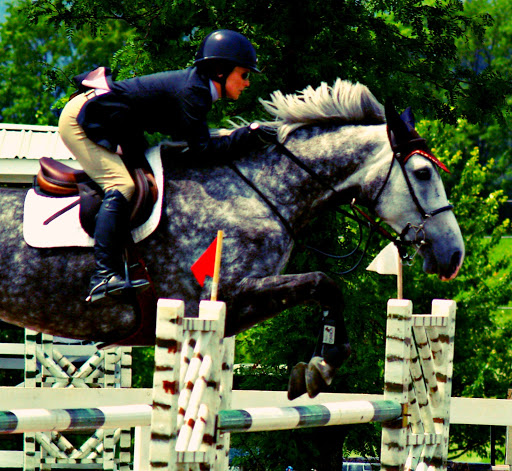
Aaron Vale rides Bromance in a jumper class Tuesday.

Roanoke Valley Horse Show underway in Salem, Va.

The Roanoke Valley Horse show kicked off Monday in Salem, Va., and will continue this week at the Salem Civic Center. Featuring hunter, jumpers, some Western classes and gaited classes, the show is a highlight of the summer in Virginia since 1972 and is rated AA — the highest level of competition in the USEF.

Tickets are required after 6 p.m. and cost $16 a night for an adult. A superpass for 3 nights can also be purchased for $17.50. However, the afternoons are free and still feature great competition, although the outdoor arenas feature limited seating. The indoor arena, however, is air conditioned and a great place to escape the June heat for the afternoon. If you can only attend one night, make it Saturday for the $50,000 Grand Prix of Roanoke, and watch out for Aaron Vale who is always one of the top riders in the event.

The show kicked off Monday night with Western pleasure, Barrel Racing and Racking classes, plus a reining demonstration that occurs on several nights. This night is typically light on participants with only a few in each class, yet the crowd is still enthusiastic. The barrel racing captures the speed-lovers’ hearts. However the arena appears to be very slick and it hinders the runners quite a bit and many of the horses struggle for their footing during their runs.

Tuesday night will feature the Welcome Jumper Stake plus more barrel racing and some Saddlebred classes. Arabians will also be featured. For those who want to make a day of it, below is the schedule for the rest of the day, which again is free to attend.

Also, for more, read this story about a RVHS veteran who has made horses his life and TV coverage of the show’s kickoff.

Tuesday 7:30 am – Coliseum

212 Reg. Conformation Model
201 Green Conformation Model
377 Open Warm Up
202 Green Conformation O/F
203 Green Conformation O/F
206 Green Conformation U/S
218 1st Year Green Working
219 1st Year Green Working
222 1st Year Green Working U/S
223 2nd Year Green Working
224 2nd Year Green Working
227 2nd Year Green Working U/S
207 HP Working O/F
208 HP Working O/F
211 HP Working U/S
213 Regular Conformation O/F
214 Regular Conformation O/F
217 Regular Conformation U/S
643 3’3” PWH O/F
644 3’3” PWH O/F
648 3’6” & 3’9” PWH O/F
649 3’6” & 3’9” PWH O/F
Course Change
533 $250 Jumper II2b (1.15m)
530 $500 Jumper II2b (1.25m)
540 $1,000 Jumper II2b (1.30m)
6:00 pm
580 $7,500 Welcome Jumper Stake
II2b (1.35m)
Tuesday 8:00am –
Hollins Ring
378 Baby Green O/F 2’6”
379 Baby Green O/F
380 Baby Green U/S
315 Schooling Hunter 3’
316 Schooling Hunter
306 Pre-Green Hunter 3’
307 Pre-Green Hunter
325 Open Hunter 3’3”
326 Open Hunter
311 Pre-Green Hunter 3’
312 Pre-Green Hunter
327 Open Hunter U/S
313 Pre-Green Hunter 3’3” U/S
384 Tinker Mt. Hunter 2’6” O/F
385 Tinker Mt. Hunter O/F
386 Tinker Mt. Hunter U/S
387 Shenandoah Hunter 2’9” O/F
388 Shenandoah Hunter O/F
389 Shenandoah Hunter U/S
Tuesday 8:30am –
VA Tech Ring
501 Low Training Jumper (.75m)
Clear Blue
564 Modified Training Jumper
(.85m) Clear Blue
505 High Training Jumper II (.95m)
Clear Blue
508 Low Schooling Jumper II2b
(1.00m)
Clear Blue
511 High Schooling Jumper II2b
(1.05m)
561 Low Child/Adult Am Jumper
II2b (1.00m)
520 $250 Jumper II2b (1.15m)
523 Modified Jr/Am Jumper II2b

$2.1 million mare at center of lawsuit

For many, buying a horse at an auction can be a nerve-wracking experience. Each horse is scrutinized by prospective owners trying to determine what may be wrong with that animal. Generally, the lower the price, the more likely something may be wrong. But what about a $2.1 million broodmare?

At the 2011 Keeneland November Breeding Stock Sale, Love Me Only an unraced half-sister to European Horse of the Year Giant’s Causeway in foal to European Horse of the Year Sea the Stars, was sold. A complaint filed in Kentucky’s Fayette Circuit Court Jan. 27, 2012 claims that her owners and consignor were aware that she may have had laminitis when she entered the sale ring.

The mare was consigned on behalf of a group of owners affiliated with Coolmore, which owns Ashford Stud in Versailles, Ky., where Love Me Only stayed for about six weeks before the sale.

On Nov. 9, 2011, the day after the sale she was shipped to Summer Wind Farm, then “on or about Nov. 10 and 11, 2011, began to exhibit physical problems and was very sore.”

On the morning of Nov. 12, 2011, Summer Wind’s regular veterinarian, Dr. Scott Pierce issued a report stating “X-rays and clinical signs indicated chronic laminitis.” On Nov. 14 the complaint says, a second veterinary report, from Dr. Bryan Fraley said Love Me Only “had an acute episode of laminitis in which (her) coffin bone had significantly sunk.” Fraley’s report expressed “concern about the longevity of Love Me Only as a broodmare.”

Summer Wind immediately notified Keeneland it intended to reject the purchase, but
Keeneland said it would not rescind the sale. According to the Conditions of Sale, buyers must state their intention to reject a sale based on a published limited warranty within 24 hours after the session in which the horse is sold and before it leaves the sale grounds. In the meantime, Summer Wind learned that Love Me Only had been administered the pain killer Butazolidin five times between Nov. 5- 8. A blood sample from Love Me Only was sent to the University of California-Davis and confirmed “large quantities of Bute,” the complaint says.

However, Love Me Only was subsequently inspected on behalf of the defendants by Dr. Ric Redden and found to be “perfectly sound.” Defendants claim veterinary records prior to the sale demonstrate the absence of laminitis.

The mare delivered a 2012 Sea the Stars foal, inspected on behalf of the defendants by Dr. Ben Stivers and found to be healthy. She was bred back to Distorted Humor.

Prance your way to fitness?

“A springy, rhythmic way of moving forward,similar to a horse’s gait and ideally induced by elation.” That is pracercise, a form of excercise that’s been around since 1989 but just recently caught on and swept the Internet, leaving many a viewer, and there has now been over 2 million, wondering “Is this for real?” 

Yes. Yes it is. At least it is to creator Joanna Rohrback.  Heck, there’s even a book: Prancercise®:The Art of Physical and Spiritual Excellence.” Get it for your Kindle at Amazon. 

Rohrback started prancercising outside, every day, on the “boardwalk” in Hollywood. People asked her about it constantly. “I think I even got it on a news clip,” she said. She quickly realized she shouldn’t keep prancercising to herself.

The video (Find it here at YouTube.) takes viewers through “trotting” to shadow-box “galloping.” Apparently this is why I was so fit as a child.  

“Let them laugh,” Joanna Rohrback told CNBC on Thursday. “Who would pay any attention to a boring, average, everyday video? I am so glad … I have my confidence.”

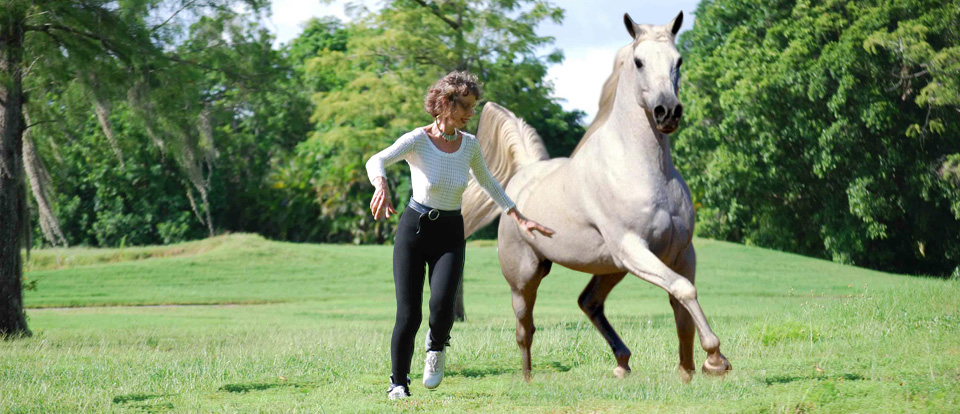
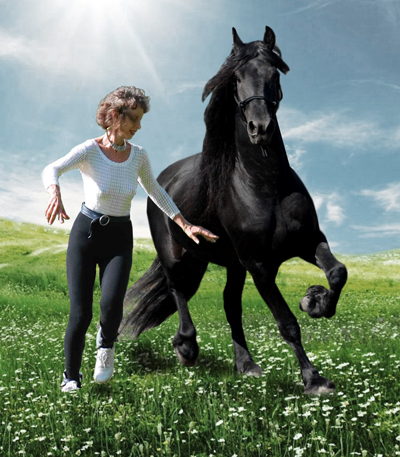
While the type of exercise is apparently real, the photos used to market Pracercise certainly are not. The two photos below use two different horses, two different fields inducing elation, but the very same pose by Rohrback as she supposedly praces along a gorgeous equine partner. 
And in all the madness that her video has stirred up, the question I would really like to have answered is: Has she ever so much as walked through a field with a horse, let alone pranced? 
And that hair! There’s a mane that any mare would be envious.