One of the area’s premiere stables is starting a new chapter.
Tracy Young Nininger has taken over the operation of Ardmore Equestrian Center in Fincastle, Virginia. Nininger, of Senoia, Georgia, brings with her over 20 years of hunter/jumper experience. As owner and operator of Jump On Over hunter/jumper facility, her riders competed on the local and A-rated circuit (Zone 4) with the Georgia Hunter/Jumper Association. Tracy has donated/volunteered with the local community, developing winning associations such as 4-H clubs, equestrian clubs, and high school interscholastic equestrian teams. A graduate of Virginia Intermont in Bristol, Virginia, Tracy majored in horsemanship/stable management with a minor in business.
Nininger’s students have not only won year-end awards with the Georgia Hunter/Jumper Association, but she has qualified winning riders for the Washington International Horse Show and had winning riders with the USEF Pony Finals several years in a row. Her riders have won top honors such as Best Child Rider on horses/ponies, sportsmanship awards, high points awards and best trainer awards. Tracy continues to ride/compete herself in the jumper/hunter divisions and also enjoys trail riding.
Ardmore Equestrian Center’s outdoor arena.
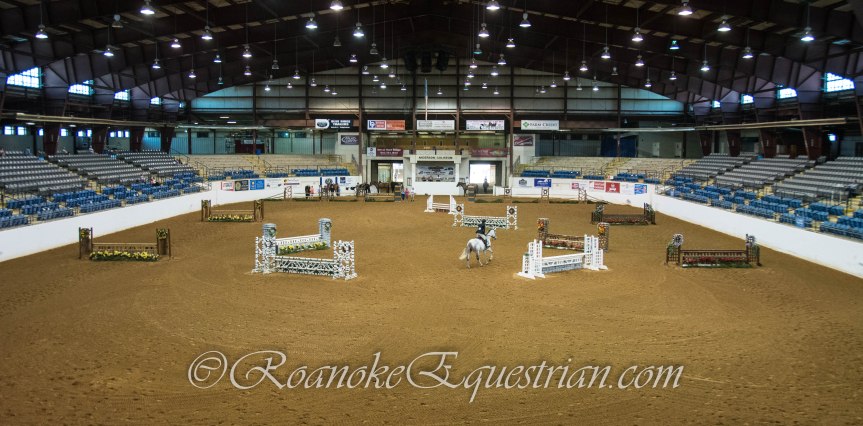
Ardmore’s 100×200 lighted indoor arena allows for riding in all types of weather.
Nininger has ridden in clinics under top professionals, including Grand Prix Olympic riders George Morris, Greg Best and Nona Garson; Big-R judge/trainer, Scott Evans; USEF Equitation Medal winner and hunter rider Anna-Jane White Mullins; and the late-great conformation trainer Sallie Sexton. Tracy’s jumper career was under the direction of the late FEI Grand Prix rider Barry Lane of Full Cry Farm in Locust Grove, Georgia.
Nininger sets high standards for all of her riders. Hard work and dedication produce winning riders. Nininger follows the George Morris system of hunt seat riding. She is thankful for all the many talented instructors/trainers that she has met along her road to success. She is happy to call Fincastle, Virginia, her new home.
Ardmore welcomes new instructor
Peyton Stevenson
Ardmore Equestrian Center welcomes Peyton Stevenson as one of its hunter instructors. A graduate of Meredith Manor Equestrian College, Stevenson brings knowledge in western riding and equine massage therapy as well as the hunters. as well as all-around knowledge of the local horse community. She is known for her professionalism, patience, love of children and the well-being of her horses while her experience competing with the Interscholastic Equestrian Association has taught her to be an all-around rider.
For more information, call Ardmore at 678-603-9458.
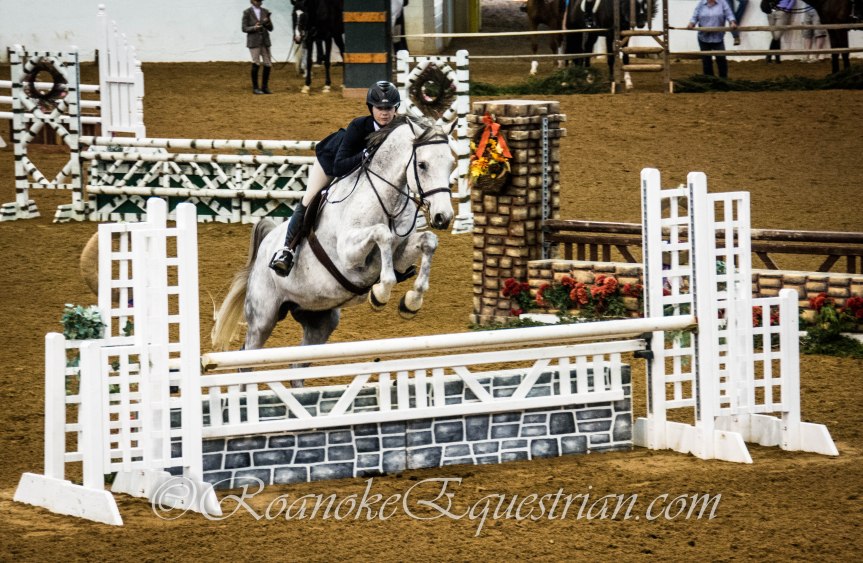
For riders who have mastered the local show courses and are looking for a well-run show in a top-notch facility, the House Mountain Horse Show at the Virginia Horse Center is an excellent step up without the pressure of a rated show.
House Mountain held its June show on June 10-11 with classes for hunters/jumpers sanctioned through SWVHJA and VHSA. Stephen Bickers, Mark Wonderly and Robin Wood judged. The show uses three arenas at the horse center including the Coliseum. The hunter divisions ran from 18 inches to 3’6″. Divisions appeared to have good numbes Saturday afternoon, with hopeful hunters a deep 20-plus group of competitors.
Along with the hunter and jumper divisions, the show also offered an Adult Medal and a Hunt Seat Meda, Oak Ridge Medal, Pony Medal, Sweet Briar Medal and the Randolph College Medal. The show also offers a division of T.I.P. Special Thoroughbred classes.
House Mountain will hold its next show on Tuesday, July 11 and Wednesday, July 12, at the horse center.
The farrier will “provide ambulatory (on the farm) farrier services to clients within the college’s practice area. The successful applicant will also provide backup coverage for, and assistance to, the in-house farrier service as needed.” Travis Burns is the in-house farrier at Virginia Tech. Burns, who joined the veterinary teaching hospital in 2010, has earned many accolades nationally and internationally and served as an official farrier at the 2010 World Equestrian Games in Lexington, Ky.
Positive interactions and professional discretion with others are necessary in the position.
“This position will also require contribution to instructional efforts of the service, specifically to farrier students, veterinary students, veterinarians, horse owners and other farriers.”
Minimum qualifications include:
Certified Farrier distinction from the American Farrier’s Association.
Successful completion of a farrier training program (or equivalent experience).
Demonstrated ability to work in a team oriented, fast paced teaching environment.
Effective communication skills.
High school diploma (or equivalent).
Rabies prophylaxis vaccine is required and will be provided by the employer.
Candidates who hold a bachelor’s degree in a related field, 24 months of farrier experience or training and the Certified Journeyman Farrier distinction from the American Farrier’s Association are preferred.
The hours will be 8 a.m.-5 p.m. Monday through Friday and pay will commensurate with experience. The position is a staff position in Pay Band 4, which runs from $32K – $74K.
The US Equestrian Federation (USEF), in conjunction with United States Para-Equestrian Association (USPEA), have announced that Healing Strides of Virginia in Boones Mill, Virginia. and Wheatland Farm Equestrian Center in Purcellville, Virginia, have been named USEF/USPEA National Para-Equestrian Dressage Centers of Excellence (COE). The USEF Selection Committee carefully scrutinized each application and upheld the highest standards upon recommending the facilities as Centers of Excellence.
Each Center of Excellence is unique in its structure and may have opportunities independent of other centers. The USEF and USPEA are committed to working with each to build plans that complement their individual strengths and opportunities. Specifically, USEF and USPEA will help COEs further develop their network with the therapeutic riding community by providing exposure to competition opportunities of interest to riders. These regional hubs of excellence will not only attract new riders to the sport of para-equestrian dressage but also work in partnership with the USEF High Performance Programs to develop athletes to a degree that they can represent the U.S. at International and Paralympic Games level and ultimately win medals.
In addition, Centers of Excellence play an active role in attracting trainers to the sport of para-equestrian dressage and helping them develop and understand the sport. COEs are the primary hubs for delivering the USEF Para-Equestrian Dressage High Performance Programs and para educational symposiums.
For more information on the COE programs please contact USEF Sport Program Assistant – Dressage / COE Coordinator, Para Equestrian, Austyn Erickson at 859-225-6929 or aerickson@usef.org.
Anne Lloyd joins Healing Strides as an advanced instructor
Anne Lloyd with a student in Colorado.
Healing Strides of Virginia, the only PATH International Premier Accredited Center
for Therapeutic Horsemanship in the Roanoke Valley, recently welcomed advanced instructor Anne Lloyd to their staff. Lloyd, a native of England, started her horsemanship career as a certified instructor through the Association of British Riding Schools.
She was active with her own daughters in the British Pony Club, and looks forward to sharing her knowledge with Healing Strides’ Pony Clubbers at HSVA. Lloyd’s passion is to be able to help any rider achieve their goals and make a lasting connection with their horse.
With 25 years of teaching and showing experience in dressage and hunter/jumper, Anne helps riding students of all levels excel and meet their personal goals. Anne has a limited number of opportunities for students to join her training schedule. Call 540-334-5825 or email Healing Strides to get to know Anne and tour the facility. The summer riding session at Healing Strides begins June 12.
The Cross View Horse Show series kicked off on Saturday, May 20, 2017, at Green Hill Park Equestrian Center in Salem, Virginia, with hunter/jumper classes before shifting into their open show on Sunday. Saturday saw a good turnout with classes varying in size from just a few riders to numbers reaching into the teens. While the youth divisions are strong, the show still lacks good numbers in the adult divisions.
A variety of classes both over fences and on the flat were held. The day was hot for May and felt more like midsummer than spring, complete with late afternoon thunderstorms rolling in and causing the show to break until they rolled past. Meanwhile, Sunday’s show would be much cooler, with the rain holding off until near the end of the show.
Cross View’s shows feature great prizes, with embroidered chairs going to the high point champions. The atmosphere is professional, yet relaxed. The jumper and hunter rings are separate and the show runs along at a decent clip with two divisions running at the same time. This also leaves the largest arena open for schooling, as well as plenty of space behind the trailers for riding. The show is a great place to take green horses for schooling or young riders for experience. And the great prizes and fun atmosphere makes is an enjoyable show for more experienced teams as well.
While Green Hill Park has been trying to raise funds to upgrade the arenas, the hunter ring (Arena 2) still appeared to be a bit hard with course crushed stone for footing. That arena was regraded last fall and now sports temporary fencing that some may recognize from the Roanoke Valley Horse Show in Salem.
The Cross View Horse Show Series continues on July 15-16. Katie Skelly will judge the hunter/jumper classes on Saturday and Tricia Mozingo will judge the open classes on Sunday. Ken Davis will judge Gaited/Trail/Games on Sunday as well. The series will close Sept. 23-24.
Gavin Moylan and Coldplay in the $30,000 George L. Ohrstrom Jr. Grand Prix at the Virginia Horse Center. Photo courtesy Phelps Media.
By Phelps Media Group, Inc.
Gavin Moylan rode his own Coldplay on May 6 to top honors in the $30,000 George L. Ohrstrom Jr. Grand Prix. Moylan and Coldplay navigated a difficult course designed by Alan Wade to best the field of 17 riders, one of only two pairs to return to the jump-off. Katie Swindler riding Alice was the other to earn a jump-off spot. Rounding out the top three was Andrea Torres Guerreiro riding Emilia.
Moylan said, “I just wanted to go quick enough and put some pressure on Katie, but I generally wanted to go clean. My horse handled it great! Standing around watching the rest of the class, I almost had the impression I was going to win without having to go in the jump off. When Katie went clean the first round I had to kind of get my mind back together a little bit and make sure I was prepared to go and do it.”
Moylan is no stranger to the Virginia Horse Center, and has been competing for the past 10 years. Moylan said, “I just loved it this last two weeks, everything about the show is great. They’ve worked on the footing a lot, the jumps were nice, the course designer was fabulous, the management team is great. I just had a really wonderful experience there. The Grand Prix win was the cherry on top!”
The second week of the Lexington Spring Festival, the Lexington Spring Encore, also included the Virgnia Horse Center Hunter Classic on Friday, May 5. Jason Berry piloted EMO Stables’ Belle Glos to the win, receiving a total score of 177 to earn the blue.
“She’s a phenomenal ride,” Berry said of the mare. “There’s not much to do because she knows all the tricks. She’s a good-hearted mare and she tries hard. She’s definitely one you can count on.”
The pair navigated the course set in the Wiley Arena to a first round score of 86 and a second round score of 91. Berry said, “It was a really nice course to ride, a lot of open canters, there was an eight- and a 10-stride line, and there was even a two stride in there. The footing in the Wiley ring at the Horse Center is really good, you have the option of setting whatever and it would be accomplishable. It was a super course to ride.”
Berry has been competing at the Virginia Horse Center for years, and is pleased with all of the updates that have taken place at the facility. He commented, “They’ve been working with Allen Reinheimer on the footing and that’s been super. I think this year was the best year. Every year the footing has gotten better and better.”
Alexa Lowe-Wiseman rode Synapse De Blondel to a win in the Rockbridge Grand Prix on April 29, 2017.
In the end, careful was more important than fast as show jumping took center stage at the Virginia Horse Center on Saturday, April 29. Alexa Lowe-Wiseman and Windsor Farm’s Synapse De Blondel were the only combination to produce a double clear effort, winning the $30,000 Rockbridge Grand Prix and Dubliner Trophy. Out of 14 entries, five returned for the jump-off, with Wiseman qualifying with two mounts.
Synapse De Blondel, a 10-year-old Selle Francais mare, had previously shown with
Wiseman in her first grand prix as a sale horse a year earlier. “My mother negotiated a trade deal with Nicholas Pio to get Blondie (Synapse De Blondel) to stay in the family after the great year we had, so it was my first grand prix with her as ours. It was very special and very exciting for Synapse De Blondel to win.”
Alexa Lowe-Wiseman and Udstrum Du Lys also qualified for the jump-off round.
Wiseman had the first and last attempt at the jump-off. Her first was aboard Udstrum Du Lys, a green horse who was competing in his first grand prix. Each competitor had a rail down throughout the jump-off when Wiseman entered the arena for her second round on Synapse De Blondel.
Christofoloni H and Manuel TorresFVF Sailor Man and Maryann CharlesFVF Sailor Man ridden by Maryann CharlesBrooke Kemper on Classified
“Normally the strategy, if everyone has had a rail, you still have to go fast because if you also have a rail you don’t want to be the slowest 4-faulter. Knowing that I was the last one on course on my chestnut mare that is so careful I actually played it safe and executed a slower, but safe, clear round. It’s nice when you know that you can count on your horse to leave the jump when you are sitting in that position.”
Although completing the fastest round in the jump-off, Colombian rider Andrea Torres Guerreiro took second place aboard her own Fifty Shades, an 8-year-old Westphalian gelding. Torres Guerreiro also owned the third place finisher for Colombia, Christofolini H, a 9-year-old Rheinlander gelding ridden by Manuel Torres.
As a native Virginian, Lowe-Wiseman looks forward to continually supporting the shows at the Virginia Horse Center. “Everyone is friendly, the horse show staff, the ladies in the office, and the stable manager. They do everything they can, including having people to run you up and down the hill in golf carts so you don’t have to walk. The grand prix is special because the crowd shows up at night and cheer you on and it’s all because of the management of the show.”
On Friday, April 28, Maria Shannon won the $3,000 USHJA National Hunter Derby, claiming victory aboard Buble’, a Danish Warmblood owned by Mohammad Attar. The pair rose to the challenge with a score of 169 to claim the Laura Pickett Perpetual Trophy, donated by Rolling Acres Show Stable.
Twenty entries competed over the Paul Jewell designed course in the Wiley Arena. Buble’ — in addition to the reserve champion, Cavallino — were trained by Shannon’s mother, Claiborne Bishop of The Barracks Farm in Charlottesville, VA. Shannon has worked for the farm since 2000 where she competes in the professional divisions.
The Lexington Spring Festival continues at the horse center and will be capped by the $30,000 George L. Olhstrom Grand Prix on Saturday, May 6.
Ranch horse competition champion Stars Stripes N Spike boxing his cow.
The Virginia Horse Center recently hosted The Great American Ranch and Trail Horse Sale, drawing nearly 170 sale horses and hundreds of potential buyers together from April 7-8. While the weekend centers around the auction of well-broke trail and working horses, it is much more than just a horse sale. Many of the horses also vied for $1,000 Ranch Horse competition or the $2,000 Trail Horse competition the day before the sale.
The trail horse competition includes eight obstacles, six of which the consignors know such as loading and unloading from a horse trailer or crossing a bridge, and two surprise elements. This year’s surprise included an adorable yet formidable donkey and the ringing of a hanging dinner bell. The course also included live chickens in a cage nearby a tent campsite, log crossings, an outhouse that required the horses to ground tie while their riders answered the call of nature and walking through brush.
All of the horses handled the course well, but only 10 could return the next morning for the trail finals. The finals included some of the same obstacles as the preliminary round, a few twists on the old obstacles, plus some new obstacles. And after each tackled the obstacles, they were given the opportunity to show off their horses in a freestyle routine that showcased the horses’ abilities. Some did reining spins and stops, illustrating their horses’ great handles, others jumped over logs, dragged barrels and spun flags and ropes over head.
In the end, a flashy 2013 sorrel APHA gelding, Doug Only Wishes, consigned by Marion G. Valerio and trained and ridden by John Roberts Performance Horses rose to the top of the 70 trail horse competitors and took home the winner’s paycheck.
Doug Only Wishes won the Trail Horse Competition.
This year, the sale also included a ranch horse competition. Horses could be shown in either of the two competitions, but not both. The ranch horse class was meant to show the horses’ abilities at working with cattle and performing ranch-type tasks. One at a time, each horse completed a working pattern, then boxed a cow and then illustrated the ability to be used to rope the cow.
Topping the class of about 15 was Hip #18 Stars Stripes N Spike, a 2004 sorrel AQHA gelding consigned by Odel & Susan H. Grose of North Carolina. He later sold in the sale for $14,500, the No. 4 high-seller. The high-seller of the sale was Hip #10 Shiners Spinning Top, who was reserve champion in the Ranch Horse Competition. The 2010 gray AQHA gelding, consigned by Steve Meadows, sold for $25,000.
Shiners Spinning Top
Gaited horses were showcased on Friday night as well in a “Gaited Horse Show Off” just prior to the start of the trail horse competition.
Besides all the competitions, horses for sale, and the general excitement surrounding the auction, the Coliseum’s concourse was packed with vendors and shoppers including booths from World Class Saddlery (who also sponsored the Ranch Horse Competition), Lucky B Trailers (who sponsored the Trail Horse Competition), Bar C Designs, Cats Tack, Cavalor Care Products, Fisher Tack, Hidden West Jewelry, In Stitches, Richard Toms and many more.
Incredibly Kool sold for $16,000.
Some other stars of the sale included Hip #56 Buckeye’s Lottery Diamond, a 2014 Gypsy Vanner/Haflinger cross tri-colored paint gelding, who sold for $20,000. He was consigned by Buckeye Acre Farm. Standing 14.3 hands high, he rode and drove.
Hip No. 24, Incredibly Kool, a 2013 sorrel gelding sold for $16,000. The proven show horse had more than 80 halter points and 30 grands and reserves.
Top 10 high-sellers:
Hip 10 – Shiners Spinning Top, $25,000
Hip 56 – Buckeye’s Lottery Diamond, $20,000
Hip 24 – Incredibly Kool, $16,000
Hip 18 – Stars Stripes N Spike, $14,500
Hip 88 – Marissa, $13,500
Hip 27 – Bo Jack BB King, $12,500
Hip 70 – Mr Montana Peppy, $11,200
Hip 46 – WR Missn Dash Jet, $11,000
Hip 36 – Home on the Range, $10,500
Hip 26 – Cowboys N Margaritas, $10,000
Prices were mixed throughout the day and went down to under $2,000. But many of the horses sold in the $4,000-$7,000 range. And several consignors didn’t get what they were looking for and “no sale” was announced at the close of the bidding. While some announcements of what the seller was looking for brought grumbles of disbelief from the crowd, at least one got what they were looking for and ended up with a sale afterall.
Next year’s sale and competitions will be April 13-14, 2018, at the Virginia Horse Center.
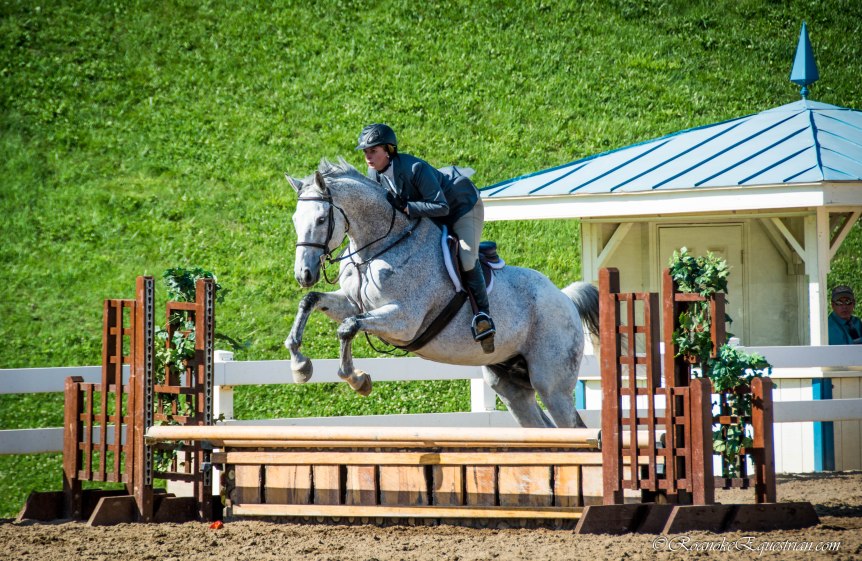
Andee Djuric rides Katie Gehrt’s (OTTB) Thoroughbred Swinging Boot over an oxer at Djuric Sporthorses in Blacksburg.
If you are looking for a place near Virginia Tech to ride hunters/jumpers, Andee and Steva Djuric have made horses their full-time business at The Stable at Hoge Pasture on Graves Avenue in Blacksburg. The hunter/jumper facility sits next to the Blacksburg Municipal Golf Course in a beautiful setting of rolling green hills. Come take a closer look at their beautiful facility and talk with Andee and Steva on Saturday, April 29, from 11 a.m. to 1 p.m. at Djuric Sporthorses‘ open house.
Q: Tell me about your stable. What kind of services do you offer?
A: We’re a small facility with a hunter/jumper focus. My husband, Steva, and I do most of the work. We are lucky to have help from a couple of really good girls who pick up when we’re at horse shows.
We offer training, lessons, coaching at shows and we’re happy to help with sales horses. The horses that board on the farm are part of our program, in training or lessons, as well as a few retirees.
Our level of involvement in racing fluctuates, but we offer boutique-style services for Thoroughbreds still intended for racing. I’m optimistic that new financial incentives for horses training in Virginia will help us expand that part of the business.
Q: When did you get started in horses? What is your riding background?
I went into the horses a bit backward from how it probably ought to be done. My mother got me a little palomino 2-year-old when I was about 10, then decided lessons might be in order after the poor thing was living in her backyard and I was kicking it up and down the driveway. A friend of hers had been stationed in Germany, where his daughter took dressage lessons and then came back to the U.S. and took up eventing. She was getting ready to start college and was willing to come out to my parents’ farm and try to help me. I can’t imagine what she must have thought when she saw us.
She got us to our first little shows, way back when Flanagan Stables was the New River Valley Horse Center, doing mostly the itty bitty hunters and equitation. I was so sure our picture was going to be in The Chronicle of the Horse.
The next two decades in a few paragraphs? Working student jobs, riding whatever anyone would let me ride, lessons with the best person I could get to at any given time, dropping out of school at Virginia Tech to ride, going back to school at Hollins – again, to ride – getting really fortunate to sit on a couple of life-changing horses with game-changing teachers and stepping into the jumper ring, trying to be a working adult amateur and finding myself at the racetrack, then just all over from Florida to Kentucky, Ohio, Indiana and the mid-Atlantic until we came back to Blacksburg.
I guess the take-away is that I believe good horsemanship transcends disciplines, even with different riding styles. I believe that correct hunter seat equitation is an outstanding foundation for any kind of riding.
Q: What makes your stable different than others in the area? What’s your specialty? What do you take the most pride in?
I’d hate to be wrong and step on anyone’s toes, but I think we’re the only full-time hunter/jumper barn in the New River Valley. This is what we do: It isn’t a hobby, it isn’t a sideline, it’s a passion that we’re fortunate enough to grow into a profession.
The Stable at Hoge Pasture in Blacksburg is next to the Blacksburg Municipal Golf Course.
We’re still growing and developing as a business, but we’re serious about good management and care. We’re serious about educating riders about helping them set and work toward appropriate goals, and I think providing a professional, consistent environment helps the horses and riders move forward.
I’m reluctant to call it a specialty, but it’s not really a surprise that we have a lot of Thoroughbreds. I think with Steva’s decades of experience riding and working with racehorses on two continents and my experience working and riding at the track over the last several years, Thoroughbreds are a pretty natural fit for us. I feel like we kind of ‘get’ them on both sides of the divide: racetrack life and post racing. I love, love, love the TB divisions offered at mainstream shows now. Thoroughbreds not only get an extra opportunity to compete, I feel like it offers just a little bit of relief from the conversation going on at the upper levels of our sport right now about medication rules. And, frankly, it gives riders trying to get into the sport at a slightly lower price point the opportunity to have some success – although there are some really nice Thoroughbreds going around now!
It’s more of an accident I think that we’re a barn with more adults than children. Again, I hate to call that a specialty because kids, when they’re into it, are just the best – simple and serious and open and just improve so fast. But for whatever reason we’re building this on an awesome group of adults who have invested their trust and dreams with us. It’s a little intense to think about how quickly and whole-heartedly these people have bought into what we’re doing here. So I hesitate to take credit for their openness, but I’d like to think that I’ve got a special connection to the adult amateur? I tried for years to balance my aspirations as a rider, first with my responsibilities as a student, then with work as a reporter and later desk work at a newspaper. I just couldn’t do it. So I have the utmost respect and appreciation for the balance these (mostly) women are trying to achieve in their careers and riding and family lives all at once – I couldn’t do what they’re doing. I want to make this work for them. That’s why we’re here. So maybe that’s also a little bit one of the things I take a great deal of pride in?
(But, honestly, bring on the kids. How else am I going to get all the cute ponies in here?!)
Q: Can you describe your training/teaching philosophy?
A: I wish I had something as simple as a philosophy. I believe in setting horses in particular and riders in general up for success? I think horses tend to be most successful and learn best when they’re relaxed and quiet. So not a big revelation that people want their hunters to be quiet, I know, but it’s something I believe in even with the racehorses – where it’s not so much a thing, right? Some trainers want the horses jumping out of their skin on race day and have a lot of success with that. I don’t know how to manage that and it isn’t my style. I think a good jumper should be relatively quiet and rideable. A horse that quietly jumps very small fences or even flats or trail rides has a marketable skill. It’s harder to find riders for anxious, difficult to ride horses at any level.
Part of that probably means I make haste slowly. I like to do a lot of flat work and small jumps, lots of repetition of basic skills like gymnastics, try to get the horses out of the arena and hacking out.
It also means I spend a lot of time worrying about the horses feeling good and getting appropriate turnout. It’s hard to make a horse show up ready to work when he’s in pain, or get him to focus when he’s just too fresh.
I’d say my teaching style is similar. The beginning and end of this riding thing is that it’s supposed to be fun. I’ve ridden with people who berate and scream and even humiliate. Then I rode with one person who was having fun – while being demanding — and it changed my whole outlook. I’ve never made more progress. I aim to be persistent and demanding, but supportive and positive. If you’re not having fun, what are you doing?
Q: What are your favorite breeds/bloodlines? What do you look for when choosing a young prospect?
A: I try to take on projects that have some appeal to the market so I’m looking for the same thing the rest of the world wants. Young horses really need to be good-minded and sound. I like to start with something at least 16 hands and with some visual appeal.
Half the hunter world seems to be riding these gorgeous C-line Holsteiners now, so that’s always interesting.
I really love to see Thoroughbreds competing under their race names because I think it helps the breed in the sporthorse world. I love to know what Thoroughbred lines are producing for sport. In general, I think turf-type runners are more likely to have the look and movement for the hunter world. There’s this popular conception in the sporthorse world that Storm Cats are tough to live with; I think that’s a little silly. Storm Cat was so popular and has become so pervasive that it’s just like saying chestnuts are tough – with so many in the world, some will be and some won’t.
I guess I just try to be open-minded and look at the individual horse. I think older TBs are underrated. Stock breeds, particularly crosses, can be really kind.
Q: Who are your riding mentors? How have they influenced your riding?
Kim Sobeck was really a game changer for me. I’d like to think I’ve taken bits and pieces of really everyone I’ve worked with and for – I’m a pilferer of words and ideas and exercises. But Kim’s emphasis on rhythm and track, her classical emphasis on equitation, the simplicity of her training style and her business acumen, she opened a door for me into the sport. It’s more than the riding. I try to think I’m grounded in her voice and her energy, but sometimes it’s as specific as starting lessons with very basic exercises we did 15 years ago or as seemingly unrelated as just being willing to put myself out there and take a chance in the world. She was the first one to really tell me I could do this for a living. She was very transparent with what she did and that’s not always a given.
She’s moved on – really when I need her more than ever! But I’m grateful for Ragan Roberts who literally walked in off the street to help. How someone at his level ended up in my barn aisle unannounced is a bit of a miracle. But I think the universe really does provide and he’s just an unusually talented individual; not many people have a system that they can articulate and apply the way he does.
Dove Houghton took me in when I needed a job in Maryland and she gave me an amazing opportunity in the racehorses. Her willingness to let me learn is unparalleled and any time I hear people without first-hand experience at the track criticize racing, it’s her barn I really think of as a model for basic good horsemanship.
About ten years ago I was blessed to spend a few months with Sulu Rose-Reed and Derek Reed. They gave me a place to go when I was struggling to find the right fit. A lot of things about how they organize their business – and keep so many balls in the air at one time –gave me a vision for things I’d like to do here.
Last summer I was with Ann Skogerboe in Texas. Months later I’m still unpacking information she gave me about riding, as well as about management and business and teaching.
Years ago I rode with longtime local trainer Ann Wallace Martin and I think a lot of my openness to non-traditional breeds and my enthusiasm for green horses begins with her. Most of what I believe about starting babies comes from her. She introduced me to the horse shows in southwest Virginia. She introduced me to the people and horses that would give me an opportunity to do more in the industry. I don’t have a start in the business without her.
Q: If you could spend the day riding with any horseman, living or dead, who would it be? Why?
That’s insanely hard! I’ve always been a huge fan of Joe Fargis and the way he appears to direct and allow the horse’s performance rather than dictate and command. It’s one of the things I just worship about Olin Armstrong, too – but I’m not sure that’s teachable?
I’m following Maryland horsewoman Deloise Noble-Strong and actively trying to make something happen there. Her blog often seems to be speaking so directly to many of the bigger concerns I see in daily life, she’s got a super analytical voice in her writing. There are fewer and fewer well-versed columnists in mainstream journalism, let alone readable, well-informed bloggers – and how many of those are speaking to the hunter world? She’s alone in her class as far as I know and I’m intrigued by her efforts to make the hunters accessible.
Most of us teach equitation and I firmly believe in the value of that. But I’m finding that equitation prepared me better for the jumper ring than the hunters — which it should do and I believe is the intent! Showing off a hunter is a different skill set and one I’m trying to reverse engineer a little? So I’m really hoping I’ll be able to set something up with her soon.
But I swear to you there are days I miss having Kim Sobeck on the rail more than I can possibly describe. I keep trying to lure her out of retirement and she won’t bite.
Q: What is the best piece of riding advice you were ever given?
A: Ragan Roberts likes to say that the horses should be teaching you, that you really should be learning from them. And that can sound a bit obvious when you’re sitting on a proclaimed schoolmaster, then a bit reductive when you’re riding around on a goofy OTTB that doesn’t know his left lead from his right… But he’s right. And when I put the riding together with the teaching and the reading and the listening, then the riding other horses, the pieces start to add up and I have these light bulbs go on. So yes, even my baby Thoroughbred has something of value to tell me.
That said, I also rode with a guy many years ago who had all kinds of one liners I find myself dredging up. And since I have a tendency to overthink and get overwhelmed, sometimes I refer back to one of his good ones – “It’s all just kicking and pulling.” And that may be an oversimplification, but sometimes that image helps me get myself a little untangled.
Q: What was your proudest moment in the saddle?
A: I’m still working on that! I’m trying really hard to appreciate the good things as they come. I have this unfortunate habit of being happy for about 1 second and almost instantly second-guessing myself and wishing that we were doing more, bigger, different.
I’ve gotten immensely proud of seeing our girls with their horses go around after all the work that we’ve put into them together. That’s huge for me.
Coming to the racehorses as an adult and starting that as a sideline, it was a little easier to enjoy the riding with a clearer perspective. I remember galloping past the grandstand on the main track and Keeneland for the first time and just grinning like a fool.
But for fun I love Jane Smiley’s Horse Heaven. There’s a book called The Horsemen, by Jack Engelhard, which is also about racing, that I just cherish. It’s definitely one of my favorite books of any kind. I’m not sure why the best horse books and movies tend to be about racing. We should probably try to fix that!
Q: You’re headed to a horse show. What one item would you never leave home without?
This is beyond the basics? Helmet, for sure, cause I’d rather not borrow that! Beyond the necessities I probably take a huge bag of clothes – a million layers if it’s cold, a dozen clean shirts if it’s hot! I guess I’m not very exciting. Gloves? I just don’t ride without gloves anymore.
Q: What one piece of advice would you give new/young riders?
Yikes. Just keep learning, stay open-minded? Because there is never an always with horses. And the moment you pop your head up and feel pretty good that you know something, horses have a way of humbling you.
I guess it just depends on what you want to get out of it. If you want to be a serious rider the standards are a little different. I saw a list circulating the internet the other day that I thought was good; it was just a recommendation of good habits for good horsemanship – one of the first items was clean your tack after every ride. The whole list was good stuff, but I believe there’s something in cleaning the tack that sets the tone? You have time to reflect on your ride, you start caring for the details, lots of things branch out from there. Somehow that turns into taking more care to make sure the tack goes onto a tidy horse, then the rider needs to be equally tidy, then the work space needs to be swept up and before you know it someone offers you a working student gig. Because who doesn’t want the polite kid who looks neat, takes care of the horse and equipment, and cleans up after herself?
Q: Tell us about the best horse you’ve ever ridden.
The best horse I’ve ever ridden is probably a school horse. They’re amazing animals. The two that I use the most right now are kind and clever and forgiving. One in particular is just a genius at pointing out – safely – an individual rider’s weaknesses.
In terms of talent, it’s just hard to say. I’ve been lucky enough to have people let me ride the truly accomplished horses. One of our customers has a pre-green type hunter now that I think could be really special.
Years ago there was the one horse that I regret not buying. He was a plain little dark bay Thoroughbred – never raced, bred for sport. He had this huge step and the most confidence, he’d been in a professional rider’s program his whole life. I did him in the pre-adult hunters for his 4-year-old year until he got sold; he didn’t have the tightest front end, especially at the little fences, so we weren’t going to set the world on fire in the hunter ring. I kind of took it for granted that he was just a nice little Thoroughbred and there would be others, but in hindsight it was a good match. He would have been a super horse for me to take to the jumper ring.
That’s something I think I didn’t place enough value on at the time.
Q: If you could try any other riding discipline, what would it be?
I guess I always thought I wanted to event? But that doesn’t really count I guess. I still kind of wish I could try riding races but I’ve seen enough up close now to know that’s a terrible idea and I would be awful.
I think it would be amazingly fun to just step off and try something completely different. I kept hoping I’d get a chance to take some reining lessons or something.
Q: What is your favorite local horse show or event? Why?
One of the girls and I were just talking about this. The Roanoke Valley Horse Show has been such a fixture for me, growing up here. Losing it to Lexington and now almost losing it completely is a little scary. Shoving all the different disciplines in a small, temporary space at the Salem Civic Center was insane. And awesome. I was always terrible in the main ring. But it was unique and it was ours, as a community. I hate that it’s moved out of town but I hope we can continue to support the event so that it remains viable.
Q: What one thing would make Roanoke a better place for equestrians?
Cover at least one ring at Green Hill Park? I think that’s such a great public resource; if there were a plan for inclement weather, it seems like it would be easy to schedule — among other things — clinicians. Education is everything, no matter what your discipline.
Q: If you could change one thing about the horse industry, what would it be?
I wish it was more accessible, mostly financially. It’s really not affordable for the average person to get started and do well, even as a hobby. Doing the right thing by a horse is expensive, education is expensive.
Q: What is your favorite characteristic in a client/student?
There’s probably not much better than a good work ethic and the ability to laugh at yourself! I love the ones who can be open-minded and just get to work trying what we ask them to do. There are a million ways to train a horse. I mean, there has to be because look at all the wildly different things you can get a horse to do! I’ll never say my way is the only way; just that it’s the best I know right now.
Andee Djuric talks with husband Steva Djuric while riding at Green Hill Park Equestrian Center.
Q: What was the biggest surprise about making riding your full-time job?
I’ve been pleasantly surprised by how open people have been to what we’re doing. Any new business struggles early on and we’ve had more support, more people respond and want to get involved, than I could have possibly anticipated.
Maybe beyond that it’s just an eye-opener to be on the other side of it. Being a working student, a DIY-type amateur, even that can only prepare you for so much. It’s overwhelming when you’re immersed and responsible for so many decisions and details. I’m always saying that it all starts with just wanting to ride a horse, right? How does that turn into operating a tractor and managing a website and editing video and running payroll and on and on. The first year I tried to do most of it myself and I pretty quickly started getting better at delegating. Steva has taken a ton of the details off of me in the last year.
Q: If you weren’t in the horse business, what would you be doing right now?
Two days ago I might have said I’d be working at a newspaper, possibly even in Roanoke. But the most recent layoffs almost certainly would have eliminated me. If it didn’t, I’d like to think I’d have moved on afterward. I strongly believe that we need professional journalists now more than ever. So maybe I’d try to rally up those veteran reporters to start their own digital outlet to compete with these media conglomerates.
Or just get started on that novel we’ve all got rattling around in our heads, right?
Capt. Mark Phillips is the new FEI course designer for the Virginia Horse Trials on May 25-28, 2017, and October 26-29, 2017.
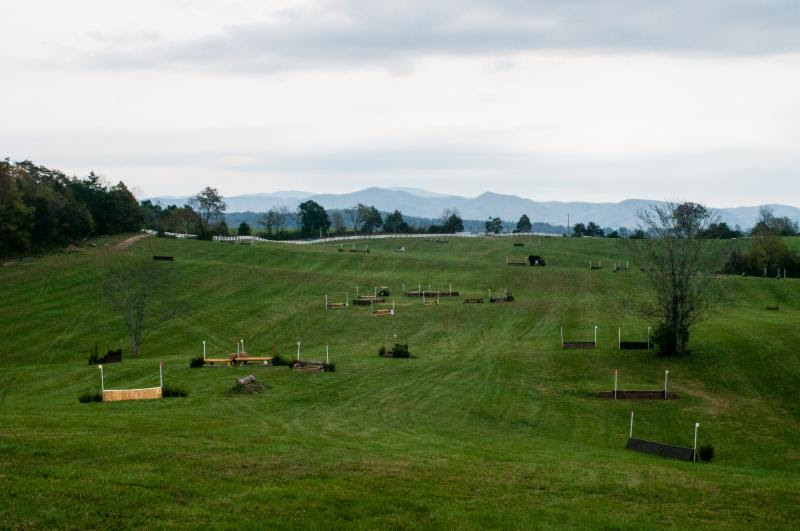
The Virginia Horse Center features two separate cross country courses, each with rolling terrain and a stunning view of the Blue Ridge Mountains.
Capt. Phillips will design the CCI*, CIC2*, CCI2* and Intermediate tracks, with VHT Organizer Andy Bowles assisting at the two-star level and John Michael Durr, designer of the Beginner Novice through Preliminary courses, assisting at the one-star level.
“We’re glad to be bringing Mark to VHT,” Bowles said. “Our hope is that his experience will increase the quality of our FEI courses and present to the competitors a challenge that is true to the level and appropriate for a destination event.”
The FEI and Intermediate competitors will experience a totally new cross country challenge than in past years. The course has been reversed and a second water complex will be built.
“There had been some concern that the Oak Hill course sent horses downhill too long near the end of the course, so to lessen the impact on the horses we reversed the track,” Bowles said. “Now all the significant climbing is done within the first third of the course. This will also place the finish line and vet box closer to the road crossing back to the barns.”
The team also received feedback on the cross-country footing and so have committed considerable efforts towards preparing the best possible galloping conditions. Construction and jump placement are scheduled to be completed early to preserve the footing on cross country, and all tracks will be aerated in advance of both competitions. Mowing has already begun and will continue on a regular basis throughout the year.
This year we’re really focused on good grass maintenance. Between mowing, aerating and keeping heavy machinery off the course as much as possible, we expect the footing to be better than ever,” Bowles said.
“We’re sincerely listening to competitor feedback and making every effort to set a high standard and provide a world-class experience for horses and riders.”
The second cross country area is home to the Beginner Novice through Preliminary courses designed by John Michael Durr. As a USEF “r” Course Designer, he joined the VHT team as part of the Course Design Mentor Program in 2015 under the tutelage of John Nicholson. As part of the natural progression for the program, Durr will be assisting Capt. Phillips in designing the one-star courses this year.
“It feels great to be involved in the design of an FEI course for the first time in my career,” Durr said. “My goal as a course designer is to educate horses and riders and prepare them for the next level. Being a part of the Mentor Program has given me invaluable experience, and I’m excited for the next step in my own education as a designer.”
The Horse Center course will also feature a newly constructed water complex that will be unveiled in May. Durr feels that this addition, as well as the multitude of other new fences constructed at VHT in the last two years, will “maximize the experience” for competitors.

 One of the area’s premiere stables is starting a new chapter.


 For riders who have mastered the local show courses and are looking for a well-run show in a top-notch facility, the House Mountain Horse Show at the Virginia Horse Center is an excellent step up without the pressure of a rated show.
 Along with the hunter and jumper divisions, the show also offered an Adult Medal and a Hunt Seat Meda, Oak Ridge Medal, Pony Medal, Sweet Briar Medal and the Randolph College Medal. The show also offers a division of T.I.P. Special Thoroughbred classes.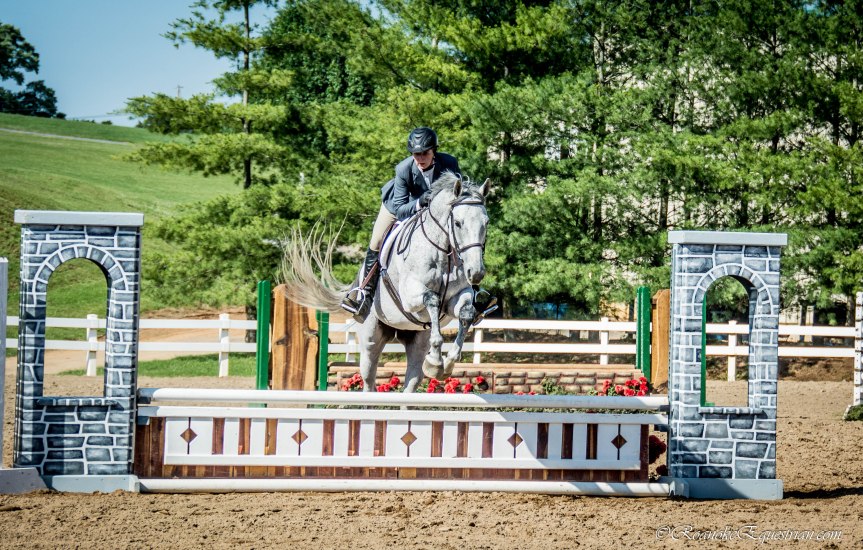
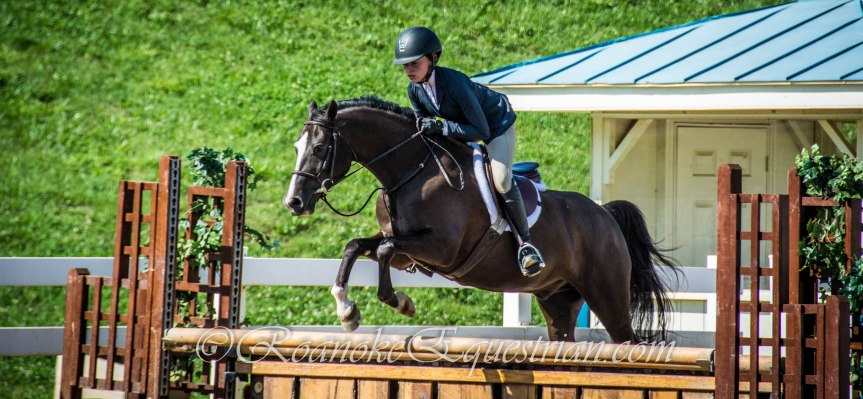


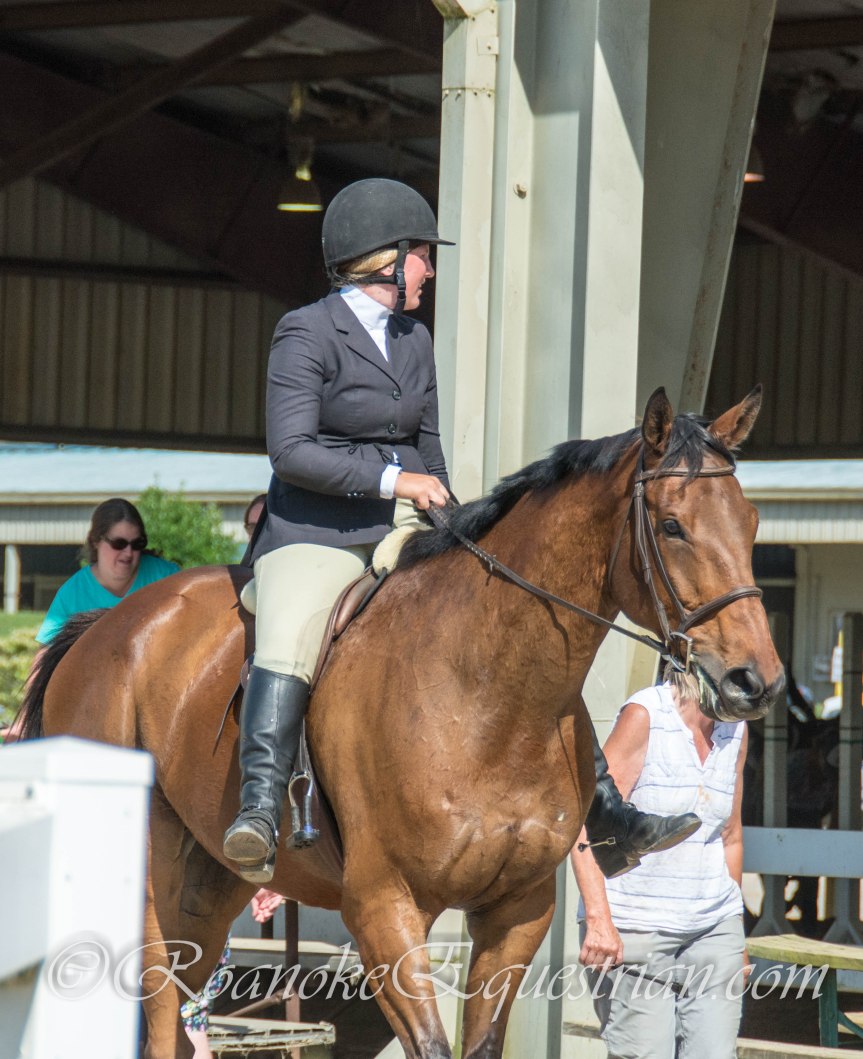

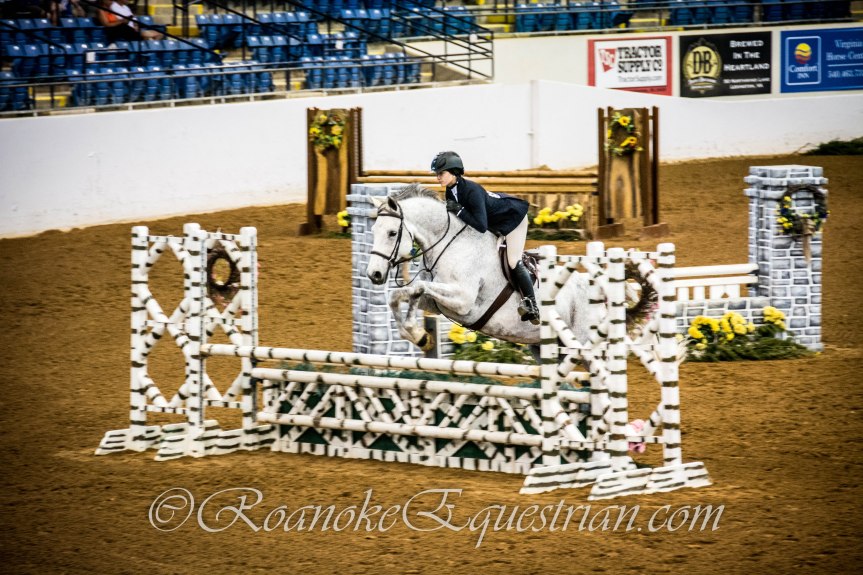

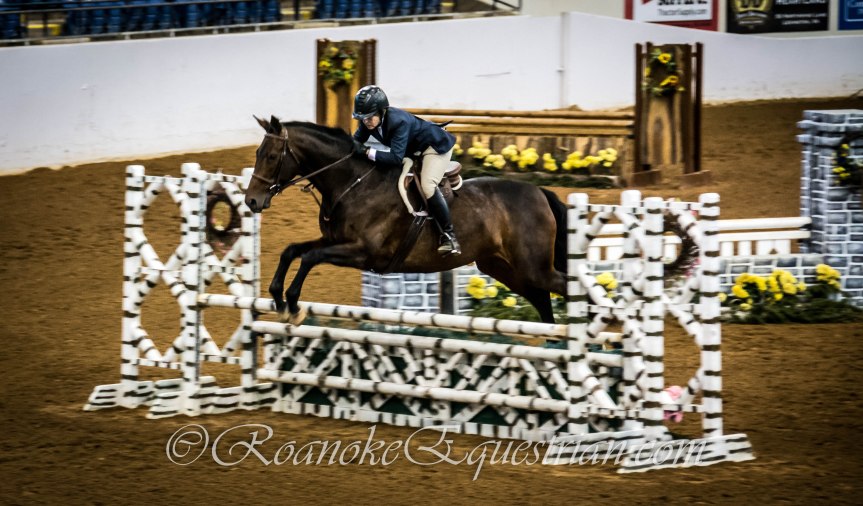









 We offer training, lessons, coaching at shows and we’re happy to help with sales horses. The horses that board on the farm are part of our program, in training or lessons, as well as a few retirees.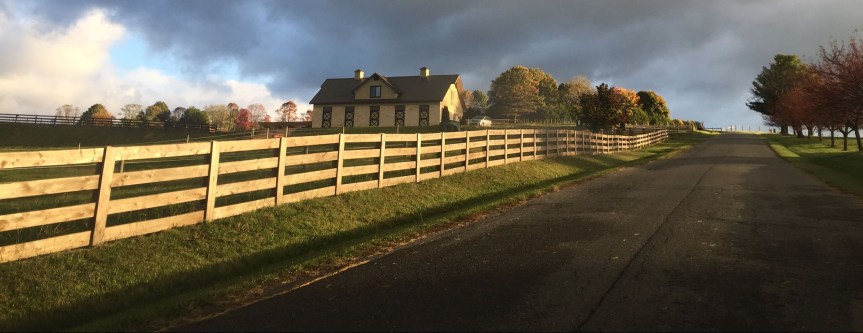
 Part of that probably means I make haste slowly. I like to do a lot of flat work and small jumps, lots of repetition of basic skills like gymnastics, try to get the horses out of the arena and hacking out.
 Roanoke Equestrian