By Virginia Tech
Until recently, clinicians at the Veterinary Teaching Hospital in the Virginia-Maryland College of Veterinary Medicine couldn’t use CT, or computed tomography, for large animals. But the recent purchase of an $85,000 table for large animals that can be wheeled to the CT scanner now allows for that option, particularly useful for studying conditions inside the heads of equine animals.
The Veterinary Teaching Hospital in Blacksburg will be the only veterinary hospital offering the capability to employ CT scans for large animals in a radius extending roughly 240 miles, to as far away as North Carolina State University’s veterinary college in Raleigh and to the Marion duPont Scott Equine Medical Center (EMC) in Leesburg, where there is a CT scanner that allows equine animals to stand during the exam.
“We have referred some of these cases to the EMC because we needed the additional information and that was the best thing for the patient,” said Chris Byron, head of the Department of Large Animal Clinical Sciences. “If they’re coming from southern Virginia or North Carolina to us, it’s a big ask to send them another 3 1/2 to four hours north. So for our region, for Southwest Virginia and into West Virginia, it’s certainly a big, big step up in capabilities.”
“We commonly use the CT scanner for imaging dogs and cats,” said Gregory Daniel, professor of radiology in the Department of Small Animal Clinical Sciences. “The current CT scanner works great for small animals, but most scanners have a 450-pound table limit. For most people and certainly for all small animals, that is sufficient. But if you’ve got a 1,000-pound patient, then a traditional CT scanner cannot accommodate that weight.”
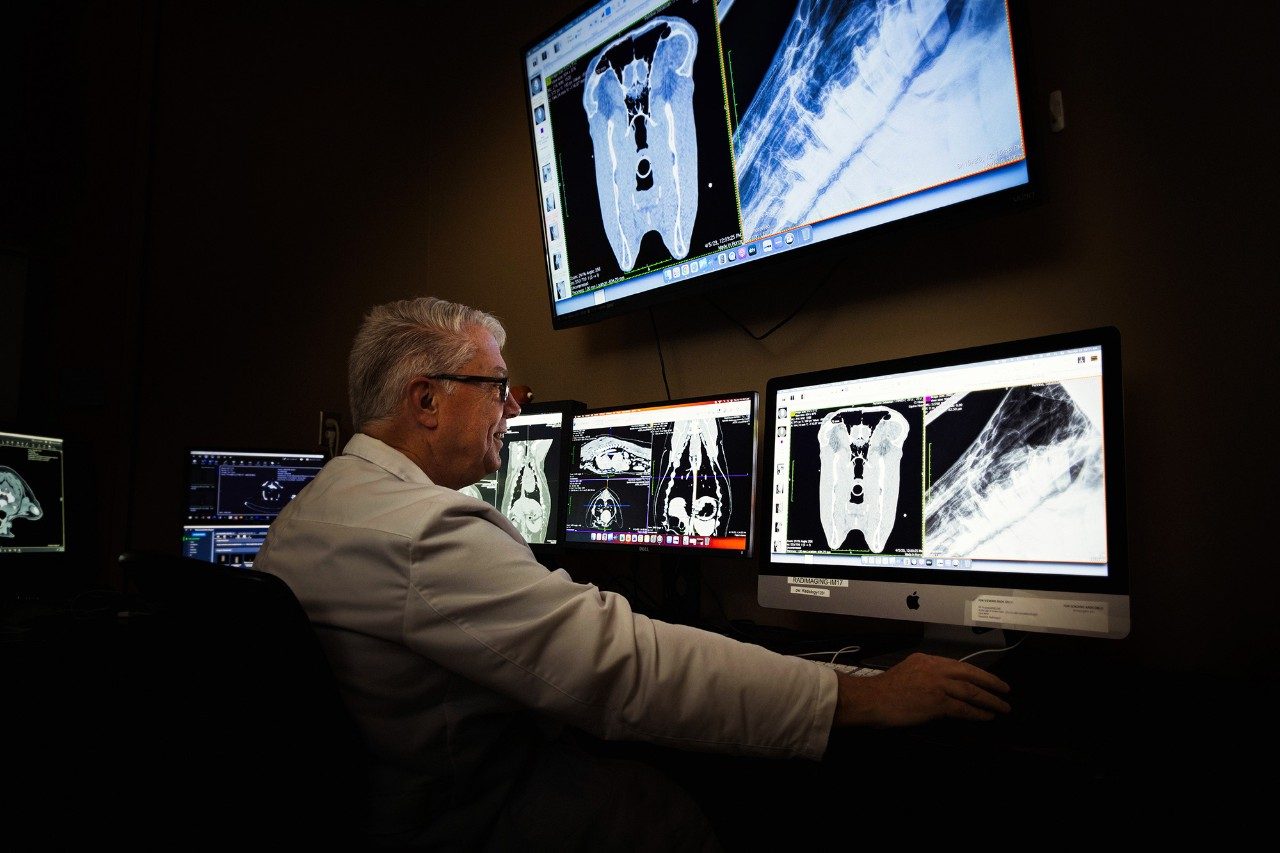
Now, a horse or other large animal can be anesthetized, laid upon the table, and rolled to the CT scanner. The table is electronically synced with the scanner, allowing it to capture slice-by-slice imagery of a large animal’s skull, teeth, and cranial cavities, providing much more detail than X-ray radiographs can reveal.
Byron and Daniel both describe the acquisition of the CT scanner table for large animals as a “game-changer.” Combined with MRI technology that does well with ligaments and cartilage of large animals’ legs and feet, plus existing radiograph and ultrasound abilities, veterinary clinicians can cover much more of a large animal’s body in examinations.
“Radiographs underestimate the extent of the disease,” Daniel said. “But the CT scanner can greatly improve our ability to diagnose diseases of the head and nasal passages.”
 Roanoke Equestrian