Emergency large animal vet added to Virginia Tech’s Vet-Med team

Horse owners in Southwest Virginia and adjacent states have faced the same nightmare: Their animal colicking at midnight with nowhere to turn or calling their regular vet only to learn they’re already handling another emergency two counties away.

Without dedicated emergency coverage, faculty veterinarians have been pulling double duty — handling scheduled appointments during the day and then working through the night when emergencies arise. By morning, they’re exhausted and still have a full day of teaching and regular cases ahead.

“It’s been difficult for the faculty to absorb that need while maintaining the daytime services, the teaching services, and the research enterprise,” said Byron.

The human cost is real, but so is the suffering of animals. Every delay means more pain for horses with colic, more risk for mares having difficult births, and more anxiety for owners watching their animals in distress.

Carla Enriquez has become the cornerstone of a new dedicated emergency service to fill a gap for Southwest Virginia’s large animal community.

She earned her veterinary degree from Universidad San Francisco de Quito in Ecudor, where she grew up, in 2019. Enriquez then headed to the U.S. for advanced training — first an internship at the University of Tennessee, then a large animal internal medicine residency at New Bolton Center, University of Pennsylvania.

After finishing her residency, Enriquez was looking for more. ‘As a resident, I always wanted to be a fellow and gain that extra knowledge,’ she said.

She pursued an emergency and critical care fellowship — two additional years of specialized training that’s still uncommon in veterinary medicine. Most veterinarians stop after pursuing one specialty due to the time, physical, and financial demands involved. Think of it as becoming a specialist within a specialty.

“The fellowship was basically like an emergency surgery residency for me,” she explained. “Coming from an internal medicine background, my goal was training in soft tissue emergency surgery and critical care by a team  of double boarded specialists in a busy emergency service .”

The result? She can handle the complex medical puzzles, infectious diseases, neonate care, ophthalmic emergencies and the surgical emergencies that walk through the door at 2 a.m. Whether it’s colic surgery, a C-section, or severe laceration, she brings both the internal medicine knowledge and surgical skills that emergencies demand.

In 2024, she became board-certified in large animal internal medicine. This August, she’ll sit for her emergency and critical care boards. Success would make her one of the few veterinarians nationwide with expertise in both areas — the perfect match for round-the-clock emergency work that demands both diagnostic depth and surgical speed.

According to available data from veterinary specialty boards, there are over 1,000 diplomates of the American College of Veterinary Emergency and Critical Care (ACVECC) in the United States, and several hundred board-certified large animal internal medicine specialists in North America. Holding board certification in both of these specialties is extremely uncommon, and it is widely considered to be rare, with only a small number of veterinarians likely to hold both credentials, and very few specializing in large animal species.

Enriquez isn’t starting from scratch. A veterinary college hospital in Northern Virginia has already demonstrated that this model is effective.

In 2023, the Marion duPont Scott Equine Medical Center in Leesburg introduced a dedicated emergency and critical care team that’s changing lives for Northern Virginia horse owners. Colic cases that once might have been lost to time delays now get immediate surgical intervention. Foaling emergencies get expert attention within the critical first hour.

The model is simple yet revolutionary: dedicated emergency veterinarians who have chosen this specialty are available when a crisis strikes — no more interrupting scheduled appointments. No more asking daytime clinicians to work all night, then show up the next morning.

Now, that same life-saving approach is coming to Blacksburg.

Enriquez will begin providing emergency services this fall as part of the college’s new program, starting with nights, weekends, and holidays — the times when emergencies can’t wait until morning. A second emergency clinician will also be joining the team this fall, allowing the service to launch fully staffed. “My goal is to help establish the emergency service here, which is down the line, going to act like a 24-hour service,” she said. “So, if you as a client or referring veterinarian have an emergency, you call the front desk, and they will direct you to one of the emergency clinicians.”

The plan mirrors what’s working in Leesburg. Eventually, students and residents will rotate through the emergency service, learning from veterinarians who chose this specialty. Details on referral protocols and service access will be announced as the launch date approaches.

Enriquez’s position exists because of a generous donation by animal advocates Karen Waldron and Shawn Ricci.

Their $4 million gift to the Veterinary Teaching Hospital is making two emergency positions possible — one for large animals, one for small animals.

“The ability to begin our emergency service with two dedicated faculty changes everything for large animal care because that allows us to position a dedicated service focused exclusively on emergency and critical care,” Byron explains. “Having dedicated emergency coverage means our other faculty can focus on their scheduled cases, teaching, and research without the constant worry of being called away for emergencies. It’s going to dramatically improve both the quality of our services and our faculty’s work-life balance.”
Virginia Tech’s hall of fame farrier takes on dual role as veterinary hospital administrator

By Virginia Tech

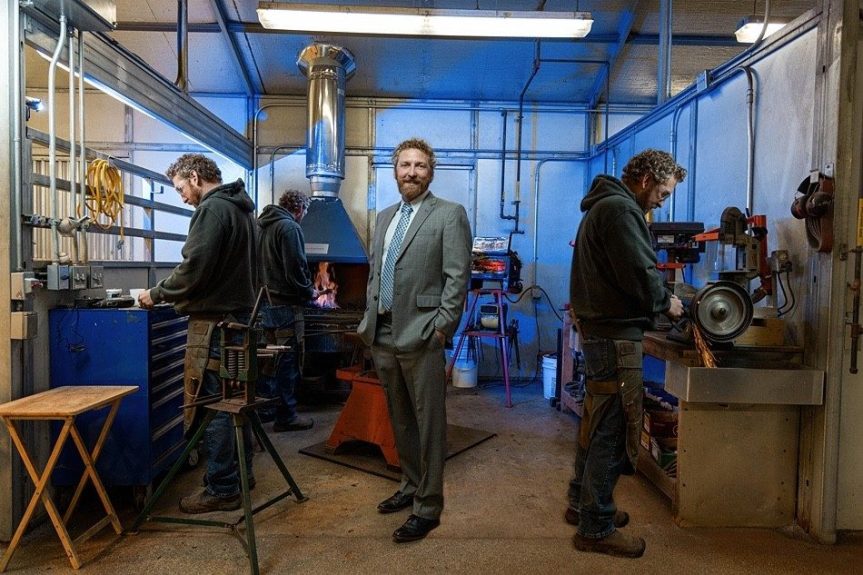
A horseshoe forged by Travis Burns in the farrier shop at the Virginia-Maryland College of Veterinary Medicine will soon be placed at the Kentucky Derby Museum, marking his induction into the International Horseshoeing Hall of Fame.

Yet even as this honor celebrates Burns’ acclaim and skill as a craftsman, he is already forging a new path as the administrator of the college’s Veterinary Teaching Hospital

“I’ve had the opportunity to serve in some leadership capacities within the college, as president of the Faculty Association, serving on the executive committee, and it really opened my eyes that there’s a lot more than my little farrier shop,” Burns said. “There’s a lot more going on here and a lot of things happening, and I really think I can help and participate. It’s another way that I can give back to the to the college.”

“Travis Burns’ reputation for excellence precedes him, both as a farrier and as a leader,” said Tanya LeRoith, director of the Veterinary Teaching Hospital. “We are delighted to welcome him into this new dual role, where his vision, skill, and commitment to both education and equine care will help drive the Veterinary Teaching Hospital toward an exciting future.”

Keeping a foot in farrier work

After a transition period over the next few months, Burns will focus 80 percent of his work duties on his new role aligning the spreadsheets and helping organize the future of a teaching hospital currently in the process of developing plans for a proposed major expansion and renovation. The remaining 20 percent will keep a foot in the farrier shop, handling some particularly difficult cases and mentoring the farriers following him.

Having received his certificate of farriery in 2003 and a bachelor’s degree in animal science from North Carolina State University in 2006, Burns joined the veterinary college in 2010 as college farrier. Later earning a master’s degree in veterinary education from the Royal Veterinary College in London in 2020 and currently pursuing an MBA at Virginia Tech, Burns has been chief of farrier services at Virginia Tech since 2010 and has steadily progressed in the academic ranks to lecturer from 2011-16), assistant professor of practice in 2017, and associate professor of practice in 2018. 

The International Horseshoeing Hall of Fame was not an expected career destination for Burns. 

“It’s not really a goal I ever set out for in in my career, but it’s certainly a very nice achievement,” Burns said. “It’s very humbling to get an award like that. I’ll admit it made me a little uncomfortable to have that much recognition, but it’s a great thing for the college, and for me personally. I think it’s a true testament to the team that I’ve been surrounded by, from the farriers that helped me get started, to the farriers that I’ve been able to work with here, to the veterinarians that I’ve been able to work with in my career.” 

Work ethic, love for learning

Burns credits his mother for instilling the values of hard work and never-ending education into him. Burns’ mother was a high school dropout who obtained a GED, associate’s degree, and bachelor’s degree while rising from a front-desk employee to general manager of a country club and inn in western North Carolina. 

“My work ethic, without a doubt, comes from my mother,” Burns said. “I was raised by a single mother who worked two jobs when I was young and went to school. When I went to kindergarten, she enrolled in night classes to get her GED. And so I would get done with school, I would go to work with her for a couple hours, and then we would go to her school. I sat in the classroom with them.

“We didn’t take holidays off. We didn’t take weekends off. She just worked hard, climbed her way up and was willing to do anything. I see that in my personality, like, here, just now going to help a surgery resident find a place for cadaver limbs to go. I still pick up trash as I walk through the parking lot. I’ll clean up the horse poop in the middle of the barn aisle. There’s no doubt that was just ingrained in me at a young age. “

Family also plays a big role in Burns’ decision to take the administrator role. His wife, Lauren Trager-Burns, is a clinical assistant professor in equine sports medicine and rehabilitation at the veterinary college. They have two young daughters, Maddie and Margot. 
 
“Having kids has changed my perspective on life, and I do want to be physically able to do all the things with them as they grow up,” Burns said. “As much as I love the farrier profession, it takes a toll on your body, but I also saw an opportunity to have a more flexible job to allow me to have more time with the family and kids.”

His farrier skills have long garnered respect and admiration. The American Farriers Journal, which oversees the Hall of Fame nominations, described Burns as among the most influential people in the horseshoeing industry over the last two decades.

A boost from the brand

Burns credits men by the name of Goodness and Pleasant for playing big roles in mentoring him as a farrier and veterinary leader.

Paul Goodness, the official U.S. Equestrian Team farrier between 1992-96, including at the 1996 Summer Olympic Games in Atlanta, developed a highly successful Loudoun County sport horse and corrective shoeing practice. Burns interned and served as an associate farrier with Goodness and Forging Ahead Farrier Associates from 2007-10. 

Goodness is the namesake of the Paul Goodness Podiatry Center at the Marion duPont Scott Equine Medical Center, Virginia Tech’s 24/7 equine emergency center and teaching hospital in Leesburg. Goodness collaborated with the equine medical center for several years, and through that relationship, Burns learned of the veterinary college at Virginia Tech and its opening for a farrier.

Once at Virginia Tech, Burns worked under the leadership of R. Scott Pleasant, professor emeritus of equine surgery and podiatry at Virginia Tech, whose leadership and vision were integral in the success of the equine podiatry program at the teaching hospital. 

Burns said the Virginia Tech connection has bolstered his career through his access to researchers and clinicians at the veterinary college and instructors in various fields across the university, as well as the extra recognition associated with being part of Virginia Tech.

“I may have still been successful, but there’s always more attention that comes with the Virginia Tech brand and the Virginia-Maryland veterinary college,” Burns said. “If I was just me with the same skill set back home in western North Carolina, shoeing horses, helping horses, I may never have got the kind of recognition that it takes to get into the hall of fame. There are many farriers all over the world doing great things for horses that may never get the recognition they deserve.”

Written by Kevin Myatt for Virginia Tech.

Related:

Video: Farrier Quick Takes (Travis Burns): New Shop at Virginia-Maryland College of Veterinary Medicine

Story: Award-winning farrier blends art, science in equine hoof care at veterinary college

Story: Virginia-Maryland Regional College of Veterinary Medicine farrier participates in World Equestrian Games