Emergency large animal vet added to Virginia Tech’s Vet-Med team

Horse owners in Southwest Virginia and adjacent states have faced the same nightmare: Their animal colicking at midnight with nowhere to turn or calling their regular vet only to learn they’re already handling another emergency two counties away.

Without dedicated emergency coverage, faculty veterinarians have been pulling double duty — handling scheduled appointments during the day and then working through the night when emergencies arise. By morning, they’re exhausted and still have a full day of teaching and regular cases ahead.

“It’s been difficult for the faculty to absorb that need while maintaining the daytime services, the teaching services, and the research enterprise,” said Byron.

The human cost is real, but so is the suffering of animals. Every delay means more pain for horses with colic, more risk for mares having difficult births, and more anxiety for owners watching their animals in distress.

Carla Enriquez has become the cornerstone of a new dedicated emergency service to fill a gap for Southwest Virginia’s large animal community.

She earned her veterinary degree from Universidad San Francisco de Quito in Ecudor, where she grew up, in 2019. Enriquez then headed to the U.S. for advanced training — first an internship at the University of Tennessee, then a large animal internal medicine residency at New Bolton Center, University of Pennsylvania.

After finishing her residency, Enriquez was looking for more. ‘As a resident, I always wanted to be a fellow and gain that extra knowledge,’ she said.

She pursued an emergency and critical care fellowship — two additional years of specialized training that’s still uncommon in veterinary medicine. Most veterinarians stop after pursuing one specialty due to the time, physical, and financial demands involved. Think of it as becoming a specialist within a specialty.

“The fellowship was basically like an emergency surgery residency for me,” she explained. “Coming from an internal medicine background, my goal was training in soft tissue emergency surgery and critical care by a team  of double boarded specialists in a busy emergency service .”

The result? She can handle the complex medical puzzles, infectious diseases, neonate care, ophthalmic emergencies and the surgical emergencies that walk through the door at 2 a.m. Whether it’s colic surgery, a C-section, or severe laceration, she brings both the internal medicine knowledge and surgical skills that emergencies demand.

In 2024, she became board-certified in large animal internal medicine. This August, she’ll sit for her emergency and critical care boards. Success would make her one of the few veterinarians nationwide with expertise in both areas — the perfect match for round-the-clock emergency work that demands both diagnostic depth and surgical speed.

According to available data from veterinary specialty boards, there are over 1,000 diplomates of the American College of Veterinary Emergency and Critical Care (ACVECC) in the United States, and several hundred board-certified large animal internal medicine specialists in North America. Holding board certification in both of these specialties is extremely uncommon, and it is widely considered to be rare, with only a small number of veterinarians likely to hold both credentials, and very few specializing in large animal species.

Enriquez isn’t starting from scratch. A veterinary college hospital in Northern Virginia has already demonstrated that this model is effective.

In 2023, the Marion duPont Scott Equine Medical Center in Leesburg introduced a dedicated emergency and critical care team that’s changing lives for Northern Virginia horse owners. Colic cases that once might have been lost to time delays now get immediate surgical intervention. Foaling emergencies get expert attention within the critical first hour.

The model is simple yet revolutionary: dedicated emergency veterinarians who have chosen this specialty are available when a crisis strikes — no more interrupting scheduled appointments. No more asking daytime clinicians to work all night, then show up the next morning.

Now, that same life-saving approach is coming to Blacksburg.

Enriquez will begin providing emergency services this fall as part of the college’s new program, starting with nights, weekends, and holidays — the times when emergencies can’t wait until morning. A second emergency clinician will also be joining the team this fall, allowing the service to launch fully staffed. “My goal is to help establish the emergency service here, which is down the line, going to act like a 24-hour service,” she said. “So, if you as a client or referring veterinarian have an emergency, you call the front desk, and they will direct you to one of the emergency clinicians.”

The plan mirrors what’s working in Leesburg. Eventually, students and residents will rotate through the emergency service, learning from veterinarians who chose this specialty. Details on referral protocols and service access will be announced as the launch date approaches.

Enriquez’s position exists because of a generous donation by animal advocates Karen Waldron and Shawn Ricci.

Their $4 million gift to the Veterinary Teaching Hospital is making two emergency positions possible — one for large animals, one for small animals.

“The ability to begin our emergency service with two dedicated faculty changes everything for large animal care because that allows us to position a dedicated service focused exclusively on emergency and critical care,” Byron explains. “Having dedicated emergency coverage means our other faculty can focus on their scheduled cases, teaching, and research without the constant worry of being called away for emergencies. It’s going to dramatically improve both the quality of our services and our faculty’s work-life balance.”
20 questions with Joe McDonald of McDonald Equine

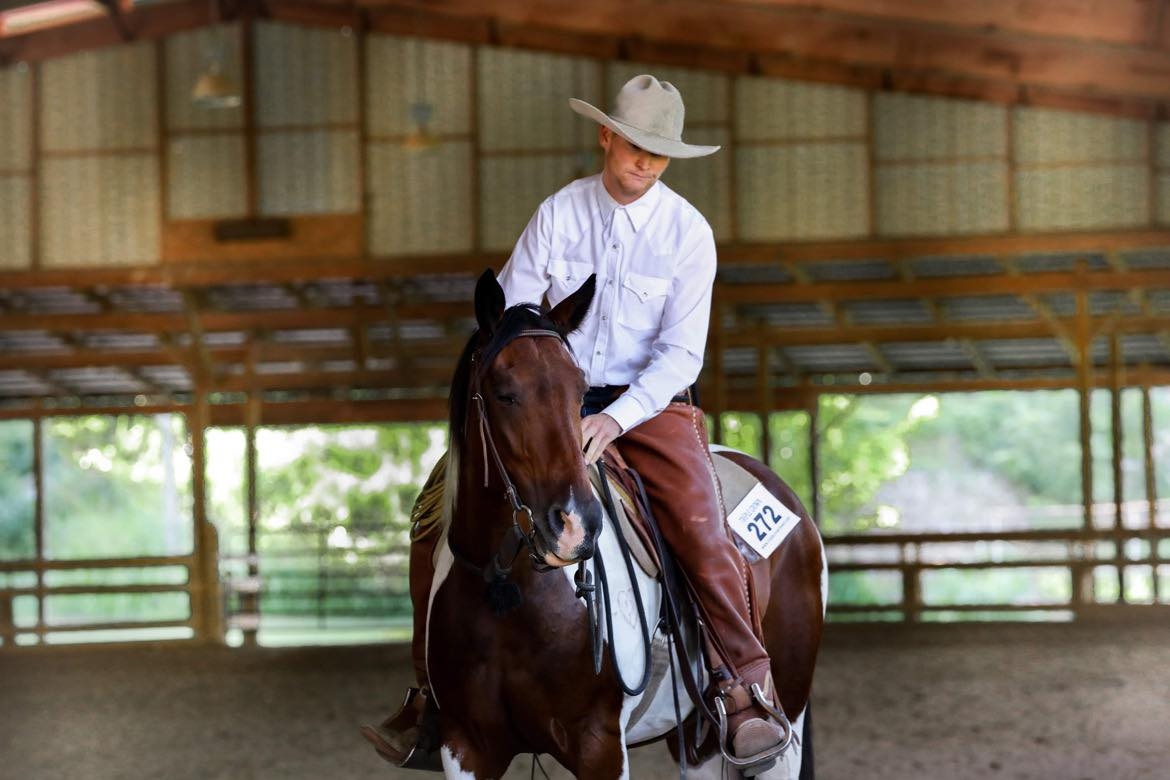
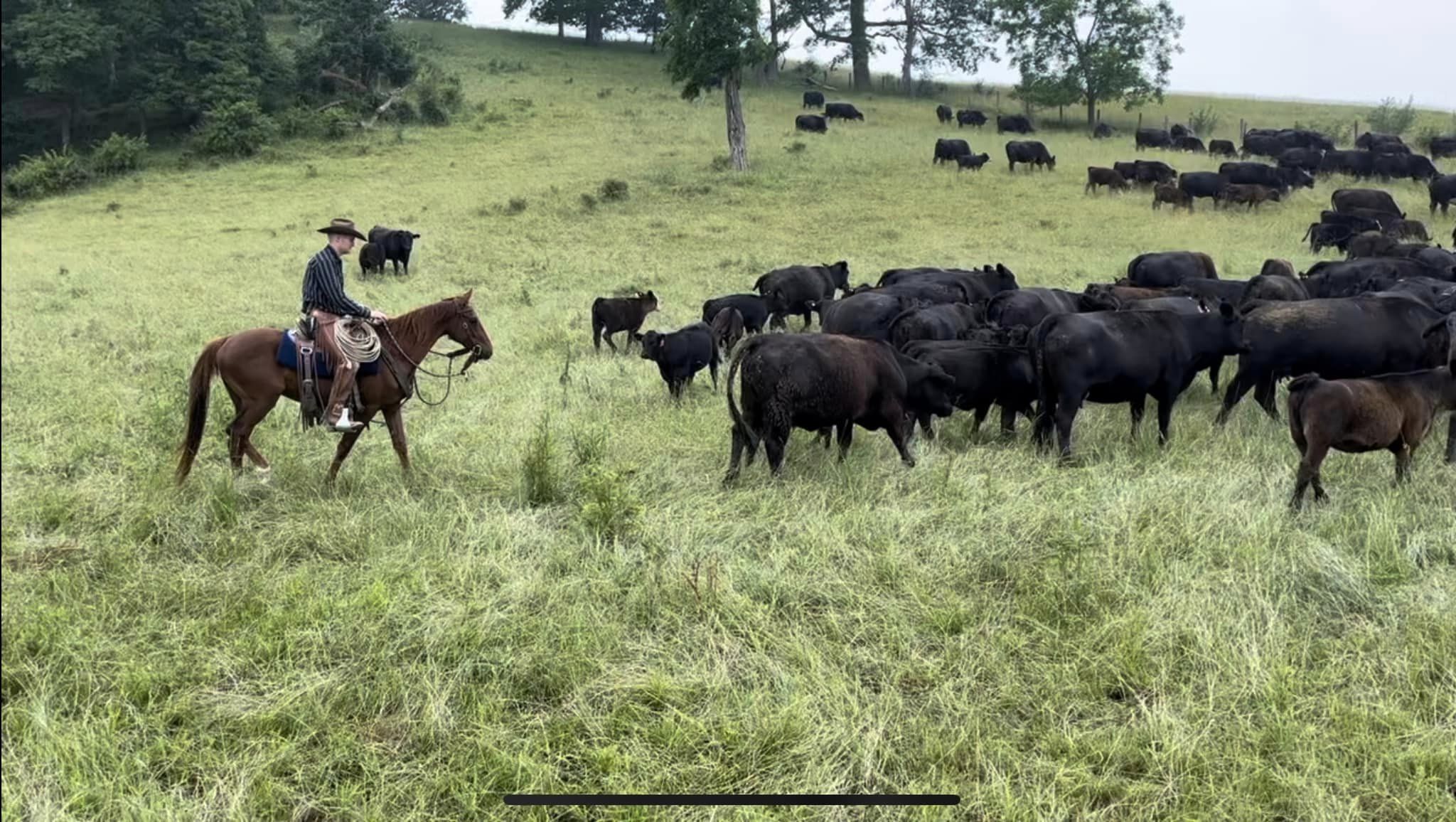
Joe McDonald grew up in Blacksburg on his family’s farm where they raised Angus, Simmental and Sim-Angus cattle. While his dad managed the farm, his mom worked in the equine industry in a variety of roles including steeplechase jockey, dressage trainer and collegiate coach.

“I grew up doing a wide range of activities with horses such as ranch work, eventing, polo, polocrosse, trail riding, etc. Today I run McDonald Equine from my family farm,” McDonald said.

Outside of work, he says, his passion with horses is to train a Californio-style bridle horse.

Tell me about your business. What kind of services do you offer?

McDonald Equine operates off of my family’s working ranch. We take in outside horses for riding. We do halter breaking. We start colts. We work with problem horses as well as refine more educated horses and offer lessons for groundwork and riding.

When did you get started in horses?

I was pretty much born into horses. Both my parents were horse people so I’ve been around horses my entire life. I do think my parents did a good job never forcing the horse thing on me, they let me have a lot of autonomy that way. I was always riding around the ranch finding something to get into. I was a part of Pony Club and 4-H, but never took it that seriously. Once I got into college, I started playing polo and showing more. The real game changer for me was when I met Buck Brannaman my first summer after college. That was the first time I realized how much someone could get done with a horse and the first time I felt like I really needed to pursue something.

What’s your specialty? What do you take the most pride in?

I think we really stand out in our handling of young horses. Folks don’t always realize how important the early years are for a horse and how easy life can be if a horse is halter broke and started properly. I also take pride in being able to empower people. I want a client to feel like they know more and can get a lot more done with their horse after they work with me. I think there are a lot of trainers that keep their clients semi-helpless in an effort to keep them around longer. I don’t want that.

Can you describe your training/teaching philosophy?

The person who has by far had the biggest impact on my philosophy is Buck Brannaman. He was heavily influenced by Ray Hunt and Tom Dorrance, so that’s sort of the school of thought I try to follow. You have to understand where a horse is coming from and present things in an appealing way. That doesn’t mean you might not have to be firm at the right time, it just means that your timing has to be set up in a way that your communication is clear. It’s not all Kumbaya and drum circles, but it’s not all conflict
either. It’s just living in the moment. I’ve been very blessed to have a lot of good teachers and I’m always trying to learn more from them.

What do you look for when choosing a young prospect? Do you have favorite breeds or
bloodlines?

I don’t necessarily have a specific breed I like. Every breed has their super stars and every breed has some duds. My ideal horse would be between 15.3hh and 16.1hh, have a large hoof (like a number 2 shoe), good bone underneath of him and it would be good if he was slightly uphill. There’s more details from a conformation standpoint that I look for, but if you don’t have good feet and solid legs, the rest doesn’t really matter.

Who are your riding mentors? How have they influenced your riding?

As I mentioned before, my biggest influence is Buck Brannaman. When I saw him ride, I knew he was the real deal and it’s what I wanted to be like. Through the horsemanship community, I’ve been fortunate enough to run into several other folks that I know and trust. Bill Barnes from Forsythe, Georgia, has had a huge impact on my life. From the very beginning he really took me under his wing and it’s rare that people have such a knowledgeable mentor that cares that much. He’s really been a blessing. Another
person is Alicia Landman from Tennessee. She has a wealth of experience in the horse industry and has an incredible amount of feel when working with a horse. She’s helped me quite a bit. Lastly, I’d have to say my friend Joel Connor from Ellensburg, Washington. Not only is he an excellent horseman, but he’s probably one of the most tenacious people I know in terms of work ethic. His council has helped me get through some tough times riding for the public and he’s helped me understand the discipline and attention to detail you need if you’re going to work with horses. All four of these people have sort of shaped me into the rider I am today and I know without them I wouldn’t have gotten very far at all.

If you could spend the day riding with any horseman, living or dead, who would it be?

Tom Dorrance, easy answer. I was too young to ever really be around Tom, but pretty much everyone I learn from today can track their line of thinking back to him. He had a photographic memory, which allowed him to learn so much and have so much feel that he could do things no one else could do with a horse. Now he’s pretty much a legend, but it would be fun to spend a day with him to see all this stuff I’ve heard stories about.

What is the best piece of riding advice you were ever given?

“Get to the feet.” I’ve heard Buck say this a bunch, and it really is true. If you can get to a horse’s feet, you have a chance of getting them to make a change. If you don’t have the feet, you don’t have much going on.

What is your proudest horse-related moment?

Any time I can watch my fiance, Kayleigh, ride a horse that I have worked with or we have worked with. It makes me proud. I love watching the horses succeed and I love watching her succeed.

Do you have a favorite horse movie or book?

Probably “Hidalgo.” For one, I love Viggo Mortensen. Also I think it’s just a good movie, period. A lot of horse movies can be a little cringy, but that’s a movie you could show to non-horse folks and they’d likely enjoy it. “The Man From Snowy River” would be a very close second.

You’re headed to a horse show. What’s one item would you never leave home without?

Probably a rope halter. If something goes out of whack with your horse, having a rope halter is a good place to start. Of course, then you have to know how to use it.

What one piece of advice would you give new/young riders?

Try to get around someone who is far more knowledgeable than you. If you’re new or you don’t know much, it can be hard to tell who is knowledgeable and who is blowing smoke. Here’s how I like to separate the two: First, listen to what they say, if you like what they say, then good. Then, watch how they ride. Just watch, don’t listen to what they are saying as they do it, because this is where the charlatans can fool people. Watch how they are getting along with their horse. Does the horse seem to be understanding? Is that what you want to look like when you’re riding? If the answer is yes, then you’re in the right spot.

Tell us about the best horse you’ve ever ridden.

The way things go at the moment, the best horse I’ve ever ridden is the next one I start because I keep getting better at offering the horse a good deal. That being said, I have a Thoroughbred mare named Betty that I ride now and she has a lot of grit and a lot of heart. There is something about a horse that you feel like you could go to war on.

If you could try any other riding discipline, what would it be?

If I lived in the right area I wouldn’t mind getting around some polo or some of the reined cow horse stuff, but I’m pretty happy with where I’m at and what I’m pursuing.

What is your favorite local horse show or event?

I always really enjoyed the Roanoke Valley Horse Show. It was cool back when A shows were more of an event for the town. Like the circus was rolling in or something. It gave the shows a lot of personality. Now they have sort of been condensed into a few big venues because of how the economics have worked out.

What one thing would make the Roanoke region a better place for equestrians?

It might be an obvious one, but investing in Green Hill Park Equestrian Center. Specifically improving the footing and maybe one day covering one of the rings. That facility has so much potential, but it does take a lot to maintain something like that. It’s a rare thing for a community to have, so it needs to be looked after.

What horse industry/riding trend do you wish would go away and never return?

There are a whole slew of people that set green riders up with young, green horses with the idea that the horse and rider can “learn together.” It’s not a fair situation for either party. Don’t get me wrong, if people want to progress with young horses, there comes a time when they need to start working with them. But in the beginning, a person (or more often a kid) needs to start with a solid horse that will give them confidence. Only after the human has some confidence about what they’re doing, can they start to give
confidence to an uneducated horse.

What is your favorite characteristic in a client/student?

Eagerness and humility. You need people that want to learn, but also they need to be humble enough to spend time learning the fundamentals. Horsemanship is like the “wax on, wax off” scene from “The Karate Kid.” You have to be willing to dedicate yourself to mastering the basics.

    What was the biggest surprise about making riding your full-time job?

    The physical aspect of it. There can be a lot of demand on your body. Not in a bad way, but I have to be aware of how I’m taking care of myself a lot more than if I had a desk job. Being stiff, tired or sore has a direct impact on me being able to do my job well.

    If you weren’t in the horse business, what do you think you would be doing right now?

    I went to school for engineering, but I’ve always been drawn to the outdoors. I think I’d probably try and do something with cattle or some sort of grazing setup. If I wasn’t in agriculture, I think I’d be interested in making a career in some sort of outdoor recreation like kayaking or backpacking.

    Local teen named AJPHA Youth Member of the Year

    Adobe-Spark-64-1-2560x1340
    Madison Martin

    Madison Martin, 15, of Evington, Virginia, is the definition of a well-rounded individual, excelling in academics, the community and the horse show industry.

    Martin was recently named the 2017 AJPHA (American Junior Paint Horse Association) Youth Member of the Year and has been named secretary of the AjPHA Executive Committee.

    “I was not expecting to win [the Youth Member of the Year] and was very surprised,” Madison said. “I know a lot of great people applied for it, so it’s an honor to be member of the year. I actually got the call I had won it on my birthday, which was a great present.”

    Youth Member of the Year is presented annually at the Youth World Show to an AjPHA member who exemplifies commitment to service and their community, scholastic achievement and leadership. The award is not given based on show-ring merits, but rather to a person who embodies the spirit of AjPHA and has a deep love for and involvement with Paint Horses. Winners receive a $1,000 scholarship and a custom Gist Silversmiths trophy buckle.

    “I got into horses because my neighbor let me ride her horse, which is now mine,” Madison said. “I have been involved with horses for quite a while now, and I absolutely love it and love Paints.”

    Beyond her involvement with the Paint Horse industry, she is also a leader in her local 4-H and Pony Club where she has been actively involved for five years.

    Outside of equine activities, Madison is a member of French Club, Fellowship of Christian Athletes and plays basketball. Going into her junior year of high school, she will begin to take dual-enrollment courses and earn college credits. She aspires to attend law school and is on the fast-track to that goal by taking an Introduction to U.S. Law class this summer at the College of William & Mary Law School.

    Volunteer work is very important to Madison. In 2016, she served as Senate Page for the Commonwealth of Virginia and volunteers in Sen. Steve Newton’s office. She gives back to her community by participating in trash pick-up days and is a volunteer for her children’s ministry at her local church.


    Staunton River High School student and her mini horse, Cash, bring joy to hospitals, schools, and even Virginia’s leaders

    cash03
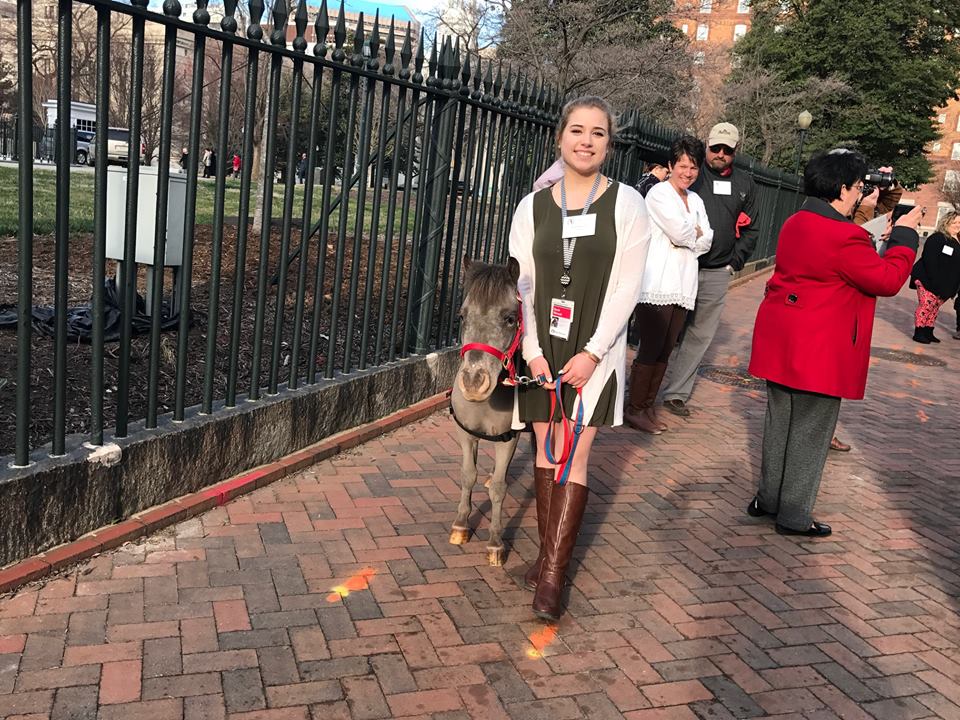
    Sarah Shinault and Cash in Richmond

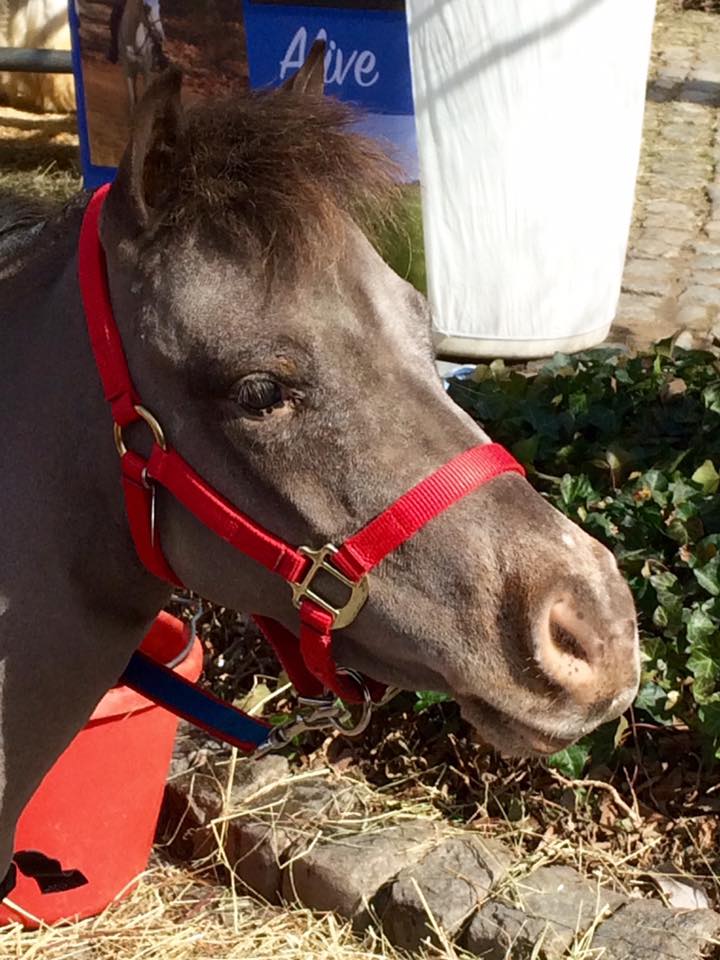
    Two years ago, Sarah Shinault, now 14 and a freshman at Staunton River High School, asked for a mini for Christmas. Her parents, Steven and Robin Shinault — who are both respiratory therapists at Carilion in Roanoke and very supportive of her love for horses — got her Cash, an Appaloosa-colored mini yearling, for her that Christmas.

    cash07Sarah has riding horses that she shows in hunter shows but she wanted a mini. She and Cash, who will be 3 in June, completed Pet Partners training and the pair are now a certified therapy team. They were the first certified miniature horse therapy team in the Roanoke area and one of only eight teams certified in the state. Cash has his own van, the Cashmobile, that is used to transport him, along with Sarah, to their appointments, with Robin Shinault acting as chauffeur. 

    Cash and Sarah go to Berkshire Nursing Home and the pediatric unit at Carilion Roanoke Memorial Medical Hospital unit regularly to visit patients. The two also have visited Patrick Henry High School. When the visits are done, Cash is treated to a drive-through meal from McDonald’s: French fries and apple slices. He eats the Apple slices and kicks the salt from the French fries.

    Recently, Cash and Sarah made a different kind of visit. On Tuesday, Feb. 21, the Virginia Horse Council sponsored a Youth Recognition Day at the General Assembly in Richmond. Young equestrians from all over the Commonwealth came to Richmond and were introduced from the gallery of the General Assembly by Rep. Terry Austin (R-19th District) and Emmett Hanger (R-24th) with thanks for their dedication. 

    About 500 people stopped by to meet the young people and the horses, including Gov. Terry McAuliffe. Sarah and Cash were there to greet the crowd and Cash shared a chat with the governor. Griffin SportHorses of Gretna, Virginia, also brought two of their superstars, a Friesian gelding and a Gypsy Vanner stallion, for the enjoyment of the legislators.